Table of Contents
Your CRM system probably knows more about your customers than you do. It remembers every email they opened, every page they visited, every time they downloaded a white paper at 2 AM. It tracks their job changes, their company’s funding rounds, and that time they attended your webinar but left after twelve minutes.
The question is: does any of this make you smarter, or just more cluttered?
We live in an era where storage is cheap and deletion feels dangerous. The result is a peculiar form of corporate hoarding. Companies stuff their CRMs with every data point they can capture, operating under the assumption that more information equals better decisions. But somewhere between capturing everything and using anything lies a growing problem that most organizations refuse to acknowledge.
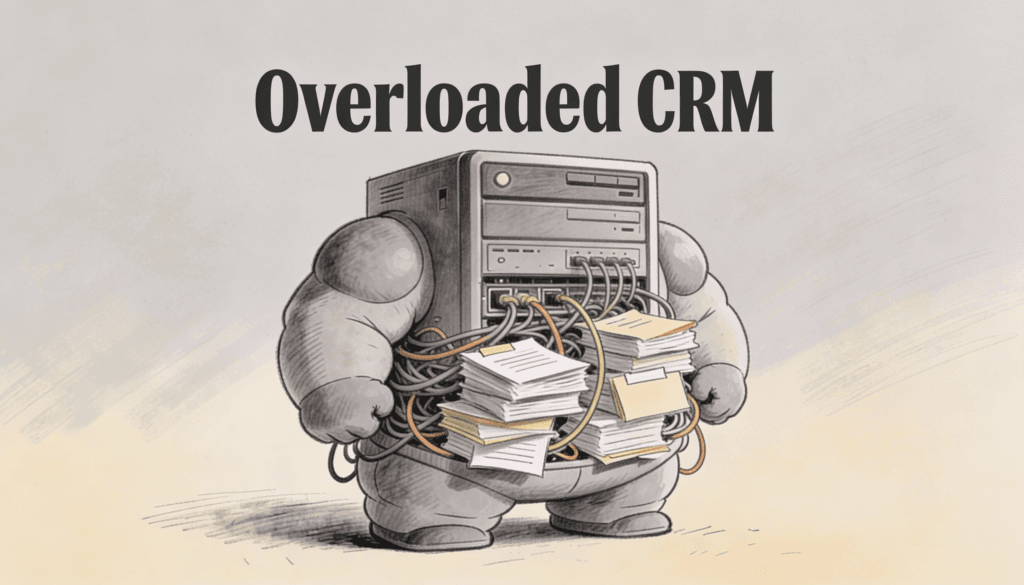
Their CRM systems have become obese.
The Buffet Mentality
Think about how people behave at all you can eat buffets. They pile their plates high, not because they’re genuinely hungry for seven different starches, but because abundance triggers a primitive response. The food is there, so they take it. Most of it goes to waste.
CRM data follows the same pattern. Fields get added because someone once thought they might be useful. Integrations multiply because the capability exists. Custom objects proliferate because different teams want different things. Nobody asks whether this data serves a purpose. Nobody questions whether anyone actually looks at it.
The average CRM database decays by roughly 25% each year. This creates a strange imbalance where the system that’s supposed to drive growth becomes a monument to accumulated decay instead.
When Fat Becomes Dysfunction
A bloated CRM doesn’t just slow down your system performance, though it certainly does that. Page load times stretch. Reports take minutes to generate instead of seconds. Sales reps wait for records to update while prospects lose interest on the other end of the phone.
But the real cost shows up in how people think.
Overloaded systems train users to ignore information. When a contact record contains 87 fields, most of them empty or outdated, people stop reading them entirely. They develop a form of learned blindness. The truly important signals get buried under layers of might be relevant someday metadata.
This is the paradox of information abundance. The more data you collect, the less any individual piece of it matters. Your CRM becomes like a library where every book ever written sits on the shelves, but there’s no card catalog and the lights are dim. The knowledge is technically accessible. Practically, it’s useless.
The Myth of Future Value
Organizations justify their data hoarding with a seductive story. We might need this later. What if this becomes important? Better to have it and not need it than need it and not have it.
This logic sounds prudent until you examine what actually happens to historical data in most CRMs. It sits. It ages. It becomes progressively less accurate as people change jobs, companies shift strategies, and markets evolve. The contact who downloaded your ebook in 2019 probably doesn’t work at that company anymore. Their interests have changed. Their needs have evolved.
Yet their ancient activity remains in your system, contributing to lead scores that no longer reflect reality, cluttering dashboards with irrelevant trends, and generally creating the illusion of knowledge where staleness has taken hold.
The future value argument also ignores a basic truth about decision making. More options don’t produce better choices. They produce paralysis. When your CRM presents fifteen different ways to segment your audience, you’ll likely fall back on the same three you always use. The other twelve exist only to make the interface more complicated.
What Speed Actually Requires
Fast companies share a common trait. They know what matters and they ignore everything else.
This sounds simple but proves remarkably difficult to execute. It requires saying no to data that seems potentially useful. It means deleting fields that someone, somewhere might want someday. It demands the kind of discipline that feels risky in a culture that worships comprehensiveness.
Speed in a CRM context isn’t really about processing power or server capacity. It’s about cognitive efficiency. How quickly can someone find the information that drives their next action? How easily can they distinguish signal from noise?
The fastest systems are often the most spartan. They track what moves the business forward and ruthlessly eliminate what doesn’t. Every field serves a purpose. Every report answers a specific question. Every integration solves a real problem rather than a theoretical one.
The Surgeon’s Perspective
Doctors understand something that business leaders often miss. Sometimes the path to health requires removal, not addition.
A skilled surgeon doesn’t approach every problem with more intervention. They know when to cut away what doesn’t belong, even if it once served a function. Scar tissue, for instance, forms as a protective response. But when it accumulates beyond what’s needed, it restricts movement and causes pain.
CRM data operates similarly. Each new field, each tracking point, each custom object represents a response to some past need or concern. Individually, they made sense. Collectively, they create restriction.
The hard part is deciding what to remove. Every piece of data has a constituency. Someone requested that field. Some team relies on that integration. Deleting feels like loss, even when what you’re losing is clutter.
This is where clear strategy becomes essential. If you can’t articulate why you’re tracking something and how it drives decisions, you probably shouldn’t be tracking it. The question isn’t whether data might be useful. The question is whether it’s actively being used to create value.
The Attention Economy Inside Your CRM
Your sales team has limited attention. Your marketing team has finite cognitive bandwidth. Every field they need to complete, every report they need to review, every dashboard they need to monitor drains from this limited resource.
Behavioral economics teaches us that decision fatigue is real. The more choices people face, the worse their choices become. By the end of a long day of updating records and reviewing data, even your best people are making decisions on autopilot.
A lean CRM respects this reality. It structures data in ways that guide attention toward what matters most. It eliminates fields that nobody reads and consolidates reports that tell the same story. It treats user attention as the scarce resource it is.
Companies that get this right often discover something counterintuitive. They close more deals with less data. Their sales cycles shorten not because they know more about prospects, but because they know the right things. Focus beats comprehensiveness every time.
The Entropy Problem
Systems naturally tend toward disorder. Leave your CRM alone for six months and watch what happens. Duplicates multiply. Fields get repurposed in creative ways. Data quality degrades as people find workarounds for processes that don’t quite fit their needs.
This isn’t a failure of discipline. It’s entropy. And the more complex your system, the faster entropy takes hold.
A CRM with 200 custom fields has exponentially more ways to break down than one with 50. Each field represents a point of potential failure, a place where data can go wrong, a spot where users can misunderstand what they’re supposed to enter.
Complexity doesn’t scale linearly. It scales exponentially. Every addition to your CRM creates new interactions with everything already there. These interactions produce unexpected consequences, edge cases, and confusion.
The antidote to entropy is simplicity. Not because simple systems are less powerful, but because they’re more maintainable. You can actually keep them clean. You can ensure data quality. You can trust what you’re looking at.
What Deletion Reveals
There’s something liberating about removing unnecessary data. It’s like cleaning out a closet you’ve been ignoring for years. You rediscover what you actually have. You see patterns you couldn’t spot before.
When companies audit their CRMs and delete what isn’t serving them, interesting things emerge. They realize they’ve been tracking metrics that nobody cares about. They discover reports that generate automatically but never get read. They find fields that were added for a campaign that ran three years ago and got forgotten.
This process reveals something important about organizational behavior. We’re often solving yesterday’s problems with today’s data. We build systems to address concerns that are no longer relevant, then leave those systems running indefinitely because changing them feels risky.
The companies that move fastest are those willing to constantly reevaluate what they’re measuring and why. They treat their CRM as a living tool that should evolve with their business, not a historical archive that must preserve everything forever.
The Real Cost of Bloat
Slow CRM systems cost money in obvious ways. Productivity drops. User adoption suffers. IT spends time managing complexity instead of driving innovation.
Your best opportunities are probably already in your CRM. But can you see them? Or are they buried under layers of irrelevant data, incomplete records, and tracking fields that nobody maintains?
This is where data obesity becomes a strategic liability. You’re not just slower. You’re blinder. The insight that could transform your business sits somewhere in your database, but finding it requires sifting through so much garbage that most people never bother.
The Path Forward
Fixing a bloated CRM isn’t a technical project. It’s a strategic one. It requires asking hard questions about what your business actually needs to know versus what it’s comfortable collecting.
Start by identifying the decisions your CRM should inform. Not every possible decision. The critical ones. The choices that determine whether you hit your targets or miss them.
Then work backward. What data do you need to make those decisions well? Not perfectly. Not with complete certainty. Just well enough to move forward with confidence.
Everything else is a candidate for deletion.
This approach feels risky because we’ve been conditioned to believe that more data equals more control. But control is an illusion when the data is too messy to interpret. Real control comes from clarity. From knowing exactly what you’re looking at and what it means.
Making Peace with Less
The hardest part of slimming down your CRM isn’t the technical work. It’s the psychological shift. It’s accepting that you don’t need to know everything. That comprehensive data collection often gets in the way of actual comprehension.
This doesn’t mean becoming careless or flying blind. It means being intentional. It means recognizing that your competitive advantage doesn’t come from having the biggest database. It comes from having the most useful one.
Fast companies aren’t drowning in data. They’re swimming through it cleanly, with strong strokes toward clear objectives. They’ve made peace with the fact that some questions will go unanswered because those questions don’t matter enough to slow them down.
Your CRM should make you faster, sharper, more responsive. If it’s doing the opposite, the problem isn’t that you need better training or more powerful servers. The problem is that somewhere along the way, you confused collection with curation.
The fix isn’t more. It’s less. But less of the right kind, implemented with the kind of discipline that separates companies that talk about being data driven from those that actually are.