Table of Contents
Project management has become a graveyard of metrics. We measure velocity, burn rate, story points, cycle time, and dozens of other numbers that promise to tell us if we’re winning or losing. The irony is that the more we measure, the less we seem to know about what actually matters.
Most project managers operate like gamblers watching every card at the table instead of tracking the odds. They collect data points the way some people collect vintage spoons: with enthusiasm but no clear purpose. The dashboard becomes a painting where every brushstroke demands equal attention, which means nothing gets the attention it deserves.
This is where the Pareto Priority Index cuts through the noise like a surgeon’s scalpel through layers of bureaucratic fat.
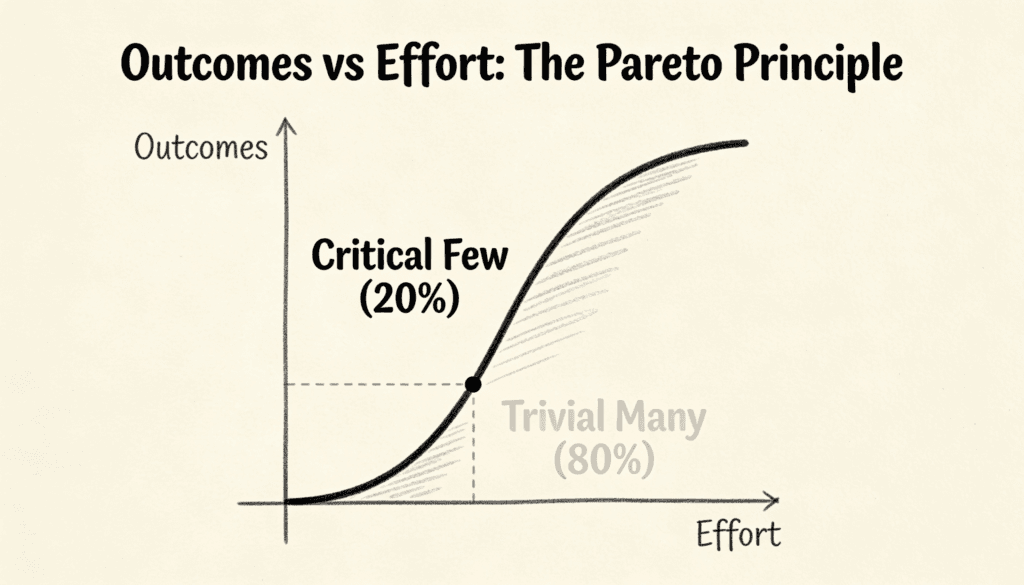
The Pareto Principle itself is almost boringly familiar. You’ve heard it a thousand times. Twenty percent of your efforts produce eighty percent of your results. Twenty percent of your customers generate eighty percent of your revenue. Twenty percent of your wardrobe gets worn eighty percent of the time. The principle is simple enough that it borders on cliché, yet most organizations treat it like a motivational poster rather than a operational framework.
The Pareto Priority Index takes this foundational insight and transforms it into something actionable. It’s not just acknowledging that some things matter more than others. It’s a systematic way of identifying which specific things matter most, then organizing your entire project execution around that hierarchy.
Think of it as the difference between knowing you should eat healthier and actually having a meal plan. One is a vague aspiration. The other is a decision system.
The Hidden Cost of Democratic Tasks
Here’s something most project management methodologies won’t tell you: treating all tasks as equally important is actually a form of strategic paralysis dressed up as fairness.
We live in a world obsessed with equality, which is generally good when we’re talking about people. But tasks are not people. Some tasks are objectively more valuable than others, and pretending otherwise doesn’t make you egalitarian. It makes you inefficient.
The traditional approach treats your project like a to-do list where crossing off items provides psychological satisfaction regardless of their actual impact. You finish ten small tasks and feel productive, even though none of them moved the needle. Meanwhile, the one task that could transform your project sits untouched because it’s harder, scarier, or less immediately gratifying.
The Pareto Priority Index forces you to confront this delusion. It demands that you assign a concrete value to each task based on its projected impact, then ruthlessly organize your resources around the high-impact items. This sounds obvious until you realize how rarely it actually happens.
Most projects operate on the squeaky wheel principle. Whatever is loudest gets the grease. The stakeholder who emails most frequently gets their feature prioritized. The bug that annoys the CEO gets fixed before the architectural flaw that’s quietly bleeding resources. Urgency masquerades as importance, and everyone stays busy without making real progress.
Building the Index: Where Numbers Meet Wisdom
Creating a Pareto Priority Index isn’t about complex mathematics. It’s about honest assessment.
You start by listing every task, feature, or deliverable in your project. Then comes the hard part: estimating the relative impact each one will have on your ultimate goal. Not the impact on keeping people happy or maintaining the illusion of progress, but the actual, tangible value to the end result.
This requires a certain intellectual courage. You’re essentially saying out loud that most of what you’re doing doesn’t matter very much. That’s uncomfortable, especially in cultures where everyone needs to feel essential.
The calculation itself is straightforward. You assign each task an impact score based on your best judgment and available data. Then you estimate the effort required. The priority index is simply impact divided by effort. High impact, low effort tasks score highest. Low impact, high effort tasks score lowest.
But here’s where it gets interesting. The real value isn’t in the numbers themselves. It’s in the conversations those numbers force you to have.
When you tell a stakeholder that their pet feature ranks in the bottom quartile of the priority index, you’re not being mean. You’re being clear. Now they can either make the case for why the impact is higher than you estimated, or they can accept that resources should flow elsewhere. Either way, you’ve moved from political negotiation to rational discourse.
This is similar to how a good financial budget works. The budget itself doesn’t make you wealthy. But the process of creating one forces you to confront reality: you can’t afford everything you want, so you must choose. The Pareto Priority Index does the same thing for project scope.
The Psychology of Priority Resistance
People will resist this framework, and their objections will sound reasonable.
They’ll argue that you can’t reduce complex project decisions to a single metric. They’re right, of course. No single metric captures everything. But this objection reveals a deeper misunderstanding about what metrics are for.
A metric isn’t meant to replace judgment. It’s meant to inform it. The Pareto Priority Index doesn’t tell you what to do. It tells you what to think about carefully before you decide what to do.
The resistance often comes from people who benefit from ambiguity. When priorities are unclear, politics fill the vacuum. The most persuasive voice wins, not necessarily the best idea. A clear priority index threatens this dynamic by introducing an objective standard that’s harder to manipulate.
Others will argue that not everything valuable can be quantified. Also true. But the alternative isn’t to quantify nothing. It’s to quantify what you can while remaining humble about what you can’t. The index handles the quantifiable parts so you have more mental bandwidth for the qualitative judgment calls.
Think about how doctors use vital signs. Your blood pressure reading doesn’t tell the whole story of your health. But it tells part of the story, and ignoring it because it’s incomplete would be absurd. The doctor uses metrics as inputs to a larger diagnostic process, not as replacements for that process.
When Everything Is Priority One
The most common project management disease is priority inflation. Everything becomes critical. Every deadline is urgent. Every feature is must-have.
This happens because saying no is hard and saying yes is easy. Marking something as low priority feels like telling someone their baby is ugly. So we avoid the discomfort by inflating everything’s importance until the word “priority” loses all meaning.
The Pareto Priority Index makes priority inflation impossible through simple arithmetic. If everything scores high, then by definition, the formula is broken. You’re either overestimating impact, underestimating effort, or both. The numbers force you to differentiate.
This has a curious psychological effect. When people know they can’t inflate everything, they become more strategic about what they fight for. The project manager is no longer a referee in an endless negotiation. They become a facilitator of a more honest conversation about trade-offs.
It’s similar to how auction systems reveal true value. When you have unlimited bids, everything can theoretically be priceless. But when you have limited currency, you suddenly become very clear about what matters most.
The Counterintuitive Power of Saying No
Here’s where the Pareto Priority Index reveals something that runs counter to most project management instinct: saying no to good ideas is often more valuable than saying yes to them.
Every good idea consumes resources. Attention, time, money, focus. The opportunity cost of pursuing a merely good idea is that you’re not pursuing a great one. But most project cultures treat every good idea as automatically worth pursuing, especially if it comes from someone important.
The index provides cover for necessary refusals. You’re not saying no because you’re negative or uncreative. You’re saying no because the math says this particular good idea ranks below other great ideas, and you don’t have infinite resources.
This is liberating for project managers who’ve spent careers trying to please everyone. You’re no longer the bad guy. The index is. You’re just the messenger, albeit one who wielded the calculator.
The best project managers use this dynamic skillfully. They involve stakeholders in building the index, making it a collaborative exercise rather than a top-down decree. When people participate in creating the ranking system, they’re more likely to accept its conclusions, even when those conclusions disadvantage their own pet projects.
Integration, Not Isolation
The mistake would be treating the Pareto Priority Index as the only tool you ever need. That’s not what “only metric you need” means. It means this is the foundational metric from which everything else derives.
You still need to track progress. You still need to monitor risks. You still need to communicate status. But all of those activities should be organized around the priority hierarchy the index creates.
Imagine your project as a solar system. The Pareto Priority Index is the sun. Everything else orbits around it. Your daily standups focus on high-index items. Your sprint planning allocates the best resources to high-index tasks. Your risk management identifies threats to high-index deliverables first.
Without this organizing principle, project management becomes democratic in the worst sense. Every task gets equal time in meetings. Every decision requires equal deliberation. You spend as much energy on item fifty-seven as you do on item three, even though item three will deliver twenty times the value.
This connects to how great investors think about portfolio allocation. They don’t spread their attention equally across every holding. They spend most of their time on their highest-conviction positions, checking in periodically on the rest. The Pareto Priority Index lets you do the same thing with project tasks.
The Time Horizon Problem
One subtle challenge with any priority system is that impact and effort both change over time. What looks low-priority today might become critical tomorrow. What seems high-impact now might become irrelevant next quarter.
The Pareto Priority Index isn’t a set-it-and-forget-it tool. It’s a living framework that requires regular revision. This is actually a feature, not a bug. The act of revisiting and recalculating forces you to confront changing conditions rather than charging forward based on outdated assumptions.
Most projects fail not because of one catastrophic decision but because they continue executing a plan that’s no longer relevant. Markets shift. Technologies evolve. Competitors move. Customer needs change. A priority index from six months ago might be measuring impact against goals that no longer matter.
Smart project managers schedule regular priority reviews, maybe monthly or quarterly depending on the project’s pace. They treat these reviews seriously, not as rubber-stamp exercises but as genuine opportunities to course-correct based on new information.
This mirrors how good strategists think about planning. The plan itself matters less than the planning process. The priority index matters less than the prioritization discipline it instills.
The Delegation Multiplier
Here’s an underappreciated benefit of the Pareto Priority Index: it dramatically improves delegation.
When priorities are unclear, delegation becomes a guessing game. You assign tasks to team members, but they don’t really know which ones matter most. So they either interrupt you constantly for guidance, or they make their own assumptions and potentially focus on the wrong things.
A clear priority index eliminates this ambiguity. Team members can see exactly where their tasks rank in the overall scheme. They know which deliverables deserve their best work and which ones just need to be adequate. They can make intelligent micro-decisions without supervision because they understand the macro-priority framework.
This is how you scale yourself as a project manager. You’re not creating dependency by being the sole keeper of priority knowledge. You’re creating autonomy by making that knowledge explicit and accessible.
Think about how GPS changed driving. Before GPS, you needed detailed knowledge or constant communication with someone who had that knowledge. After GPS, you could navigate independently because the knowledge was encoded in a system you could access. The Pareto Priority Index does something similar for project navigation.
Why This Works When Other Metrics Fail
Most project metrics measure activity rather than value. Lines of code written, tickets closed, hours logged. These metrics are easy to track but nearly meaningless for project success.
The Pareto Priority Index is different because it starts with value and works backward to activity. It asks what outcomes matter most, then organizes activities around delivering those outcomes. This seems like an obvious approach, but it’s surprisingly rare.
The reason is simple. Measuring activity is easier than measuring value. You can count tickets closed with perfect accuracy. Estimating the value of solving a particular customer problem requires judgment, context, and sometimes uncomfortable honesty about what you don’t know.
Most organizations choose easy over accurate. They’d rather have precise measurements of meaningless things than rough estimates of meaningful things. The Pareto Priority Index forces you to do the harder, more valuable work.
…
Implementing a Pareto Priority Index won’t magically solve all your project problems. Tools don’t solve problems. People do, using tools as leverage.
What the index provides is clarity. And clarity, while not sufficient for success, is absolutely necessary. You can’t reach a destination you haven’t clearly defined. You can’t prioritize effectively when everything is allegedly equal. You can’t make good resource allocation decisions without some framework for comparing options.
The beauty of the Pareto Priority Index is its simplicity. It’s not a complex methodology requiring certification and consultants. It’s a straightforward framework that makes implicit priority decisions explicit, then holds you accountable to them.
In a world drowning in complexity, sometimes the most sophisticated move is to simplify ruthlessly. To stop tracking everything and start tracking what matters. To acknowledge that some tasks are more valuable than others, organize around that truth, and execute with clarity.
That’s not just good project management. That’s good thinking.