Table of Contents
Every organization claims it wants innovation. They put it in mission statements, splash it across recruitment materials, and invoke it during keynote speeches. But when you actually try to innovate, you discover a peculiar truth: most organizations are structured to reject the very thing they say they want.
The problem isn’t that managers are obstinate or uncreative. The problem is that innovation and management operate on fundamentally incompatible timeframes and risk profiles. Innovation asks for resources now with payoffs later and uncertain. Management needs predictable outcomes within existing budgetary cycles. Innovation threatens the metrics that currently show success. Management gets evaluated on those metrics.
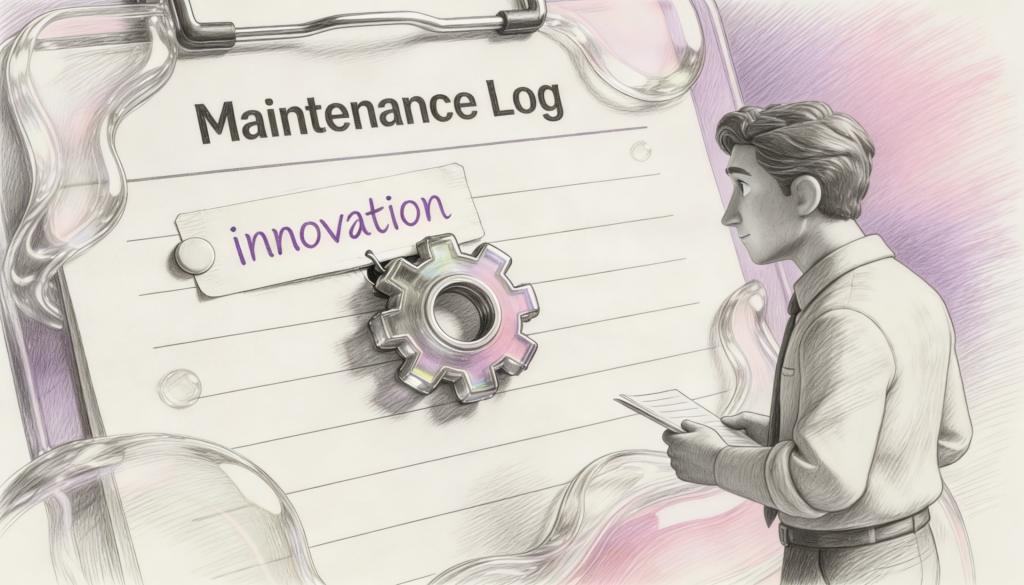
So what do you do when you have a genuinely good idea that would improve your organization, but you know the formal innovation process is a graveyard? You reframe it as maintenance.
This isn’t about deception. It’s about translation. You’re speaking the language your audience actually understands rather than the language they claim to prefer.
The Paradox of Explicit Innovation Programs
Most companies have innovation programs. Many have innovation labs, innovation officers, and innovation budgets. These programs fail with remarkable consistency.
Why? Because once you label something as innovation, you’ve automatically placed it in a special category that receives special scrutiny. It needs to be defensible as innovation. It needs to be novel enough to justify the innovation budget but not so novel that it seems risky. It needs to promise transformative results but also demonstrate clear ROI within the current planning horizon.
These requirements are nearly impossible to satisfy simultaneously. So innovation programs become theater. They fund safe bets that aren’t actually innovative, or they fund genuinely novel ideas that get killed the moment they require real resources.
Meanwhile, some of the most significant innovations in organizational history happened without anyone calling them innovations. They happened because someone found a way to make them seem like the obvious next step. Like basic upkeep. Like common sense.
Consider the introduction of electronic medical records in hospitals. When pitched as “innovation in healthcare delivery,” it faced enormous resistance. Too expensive. Too disruptive. Too risky. When reframed as “necessary infrastructure maintenance to reduce medication errors and meet regulatory requirements,” the same system got approved. Same technology. Different framing.
Why Maintenance Gets Approved
Maintenance has several advantages that innovation lacks.
First, maintenance is inherently defensive. You’re not asking to build something new. You’re asking to prevent something bad. And humans are loss averse. We respond more strongly to potential losses than to equivalent gains. A manager who might reject a 20% efficiency improvement will approve a project to prevent a 20% efficiency decline, even if the actual work is identical.
Second, maintenance connects to existing pain points. Everyone already knows something is broken or degrading. You’re not asking them to imagine a better future. You’re offering to fix a present problem they already acknowledge.
Third, maintenance has built in justification. Equipment breaks down. Software becomes obsolete. Processes accumulate workarounds. These are facts, not projections. You don’t need to convince anyone that maintenance will eventually be necessary. They already believe it.
Fourth, maintenance budgets are different from innovation budgets. They’re boring. They’re assumed. They don’t get the same scrutiny because they’re not promising glory. And that lack of scrutiny is precisely what gives you room to work.
The Art of Reframing
Reframing innovation as maintenance isn’t about lying. It’s about choosing which true aspect of your project to emphasize.
Every real innovation solves a problem. If it didn’t, it wouldn’t be valuable. The question is whether you emphasize the novelty of the solution or the urgency of the problem.
Let’s say you want to implement a new collaboration tool that would fundamentally change how your team works. If you pitch it as “adopting cutting edge collaboration technology to transform our workflow,” you’re asking for an innovation approval. You’ll need to demonstrate thought leadership, competitive advantage, and transformative potential.
If instead you pitch it as “replacing our current aging system which no longer receives security updates and lacks integration with our other tools,” you’re asking for maintenance approval. You’re solving an obvious problem with available technology.
Same tool. Same implementation. Different emphasis.
The key is that both framings are honest. The collaboration tool really is solving a security and integration problem. It also happens to enable new workflows. You’re not hiding the benefits. You’re just not leading with them.
Finding the Maintenance Angle
Almost any innovation can be reframed as maintenance if you look carefully enough.
Are you proposing a new process? It’s not innovation. It’s eliminating the inefficiencies and workarounds that have accumulated in the current process.
Are you suggesting new technology? It’s not innovation. It’s replacing legacy systems that pose security risks or compatibility problems.
Are you recommending a new approach to customer service? It’s not innovation. It’s addressing the documented decline in satisfaction scores and the increasing cost of handling complaints the old way.
The maintenance angle usually lives in one of these areas: risk reduction, cost containment, regulatory compliance, or competitive parity. Notice that none of these promise to make you better than others. They promise to keep you from falling behind. That’s a much easier sell.
Think about how cloud computing actually spread through enterprises. It wasn’t sold primarily as innovation. It was sold as reducing the maintenance burden of running physical servers, improving disaster recovery, and ensuring security patches got applied consistently. The scalability and flexibility were bonuses, not the main pitch.
The Problem of Success
Here’s where things get interesting. If you successfully reframe innovation as maintenance, you create a new problem. When your project works, it won’t be recognized as innovation.
This is fine if your goal is to actually improve things. It’s problematic if your goal is to get credit for improving things.
You have to decide what you care about more: getting things done or getting recognized for getting things done. These aren’t always compatible objectives.
Many of the best operators in any organization are people who’ve mastered the art of making things happen without needing credit. They’re not in the innovation spotlight. They’re not giving TED talks. They’re just steadily making their organizations better by framing improvements as obvious next steps rather than bold initiatives.
There’s something almost subversive about this approach. You’re innovating by pretending you’re not innovating. You’re changing things by insisting you’re just maintaining them.
When Not to Use This Approach
Reframing innovation as maintenance isn’t always the right strategy.
If you’re working on something genuinely unprecedented that requires substantial resources and cross functional coordination, you probably can’t hide it under a maintenance budget. At some point, someone will notice that your “maintenance project” is consuming innovation level resources.
If your innovation requires changing power structures or threatening established interests, no amount of reframing will help. When people stand to lose status or resources, they’ll see through your framing and resist anyway.
If you’re in an organization that actually has functional innovation processes, you should use them. Some companies really do manage to fund and support genuine innovation through formal channels. They’re rare, but they exist.
And if getting credit for innovation is important to your career trajectory, maintenance framing actively works against you. You might get things done, but you won’t get recognized as an innovator.
The Deeper Pattern
There’s a broader principle at work here that extends beyond innovation and maintenance.
Organizations develop antibodies against change. Not because they’re stupid or malicious, but because stability is genuinely valuable. Most changes are bad ideas. Most proposals waste resources. Most new initiatives fail.
So organizations build systems to say no. They create approval processes, budget categories, and evaluation criteria that make it hard to do anything new.
These systems aren’t bugs. They’re features. They protect the organization from chaos and distraction.
But they also create a challenge for the small minority of changes that really would help. Good ideas die alongside bad ones because the system can’t easily tell them apart.
The solution isn’t to break the system. The system is doing its job. The solution is to work with the system by presenting your idea in a form the system is designed to approve.
This same pattern appears in other domains. In academic research, genuinely novel work often gets published by framing it as a minor extension of existing literature rather than a paradigm shift. In politics, major reforms sometimes pass by being described as returns to original principles rather than dramatic changes. In product development, breakthrough features often get approved as bug fixes or performance improvements.
The pattern is universal: when you want to change something, describe it as preserving something.
The Ethics of Strategic Framing
Is this manipulative?
That depends on your intent and honesty. If you’re genuinely solving real problems and you’re transparent about what you’re doing, it’s just effective communication. If you’re hiding costs, exaggerating problems, or misleading people about outcomes, it’s manipulation.
The test is simple: would you be comfortable explaining your framing choice if asked directly? If someone said, “This seems more like innovation than maintenance,” could you defend your categorization honestly?
If your maintenance framing is just emphasizing the problem solving aspect of your innovation rather than the novelty aspect, that’s legitimate. You’re highlighting a true dimension of your work.
If your maintenance framing involves fabricating urgency or hiding the scope of change, that’s dishonest.
The line matters because organizations run on trust. If you abuse maintenance budgets to fund pet projects disguised as necessities, you’ll poison the well for everyone. Future maintenance requests will get more scrutiny. Actual necessary maintenance might get delayed.
Use this approach surgically, for things that genuinely matter, not tactically for everything you want to do.
Making It Work
If you decide to reframe innovation as maintenance, here’s how to do it effectively.
Start with genuine problems. Don’t invent them. Every organization has real issues. Find the ones your innovation actually addresses and lead with those.
Use boring language. The more exciting your description sounds, the more it seems like innovation rather than maintenance. “Upgrading legacy systems” is better than “modernizing our technology stack.” They mean the same thing, but one sounds like maintenance and one sounds like innovation.
Connect to existing initiatives. Maintenance that supports already approved priorities is easier to approve than maintenance that stands alone. If your organization has committed to improving customer satisfaction, frame your project as maintaining the capacity to meet those satisfaction targets.
Provide comparison points. Show what happens without the maintenance. This isn’t fear mongering. It’s realistic planning. What are the actual consequences of not doing this work?
Break it into phases. Big projects trigger innovation scrutiny. Small projects slide through as maintenance. If you can decompose your initiative into a series of incremental improvements, each one is easier to approve.
Document the deterioration. If you’re claiming something needs maintenance, have evidence that it’s actually degrading. Metrics help. Examples help. Anything concrete that shows the current state is unsustainable.
The Bigger Picture
The need to reframe innovation as maintenance reveals something important about how organizations work.
They’re not primarily designed to improve. They’re designed to persist. Improvement is secondary to survival.
This isn’t a flaw. Organizations that constantly chase improvement often implode. They change too fast, lose institutional knowledge, and exhaust their people. Some stability is healthy.
But total stability means death. The environment changes. Technology changes. Competitors change. Organizations that can’t adapt gradually become obsolete.
The solution is evolution disguised as conservation. Change that doesn’t feel like change. Innovation that looks like obvious upkeep.
This is how natural selection works too. Mutations are just maintenance errors in DNA copying. The ones that help persistence get kept. The ones that don’t get filtered out. Evolution is innovation that happened by accident while trying to maintain.
Maybe organizations work the same way. The ones that survive are the ones that accidentally innovate while trying to maintain themselves.
And maybe the best thing you can do as someone who wants to make things better is to help those accidents happen a little more often.