Table of Contents
Most businesses don’t die from bad decisions. They die from no decisions at all.
You sit in meetings where everyone nods. Your products still sell. Customers still pay. Revenue looks stable, maybe even slightly up. Yet something feels wrong, like watching a plant that hasn’t grown in months but hasn’t died either. It just exists.
This is stagnation, and it’s invisible until it isn’t.
The Ansoff matrix offers a surprisingly quick diagnostic for this exact problem. Not as a growth strategy tool, which is how most people use it, but as an audit mechanism. A way to hold up a mirror and see if your business has quietly stopped moving.
The Ansoff Matrix as Mirror
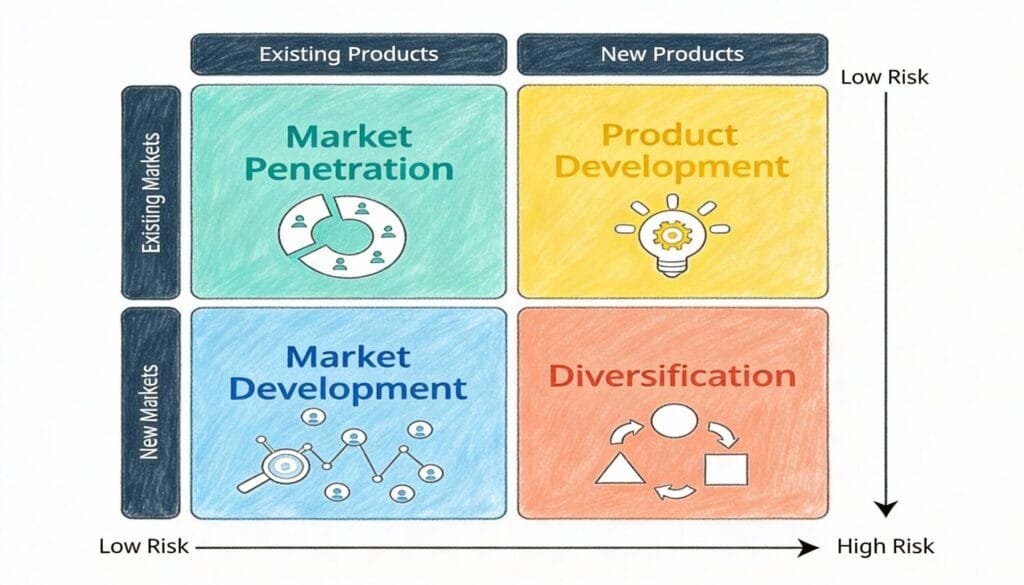
Igor Ansoff created his famous grid in 1957, proposing four paths for growth: selling existing products to existing markets, new products to existing markets, existing products to new markets, or new products to new markets. Most executives can sketch this on a napkin. Few use it honestly.
The real value isn’t in the matrix itself. It’s in forcing yourself to answer where your actual energy goes versus where you think it goes. This gap between perception and reality is where stagnation lives.
Take ten minutes. Seriously time it. Look at where your business invested its resources over the past year. Not where the strategy deck said you would invest, but where the money and hours actually went. Which quadrant ate up most of your thinking, your budget, your best people?
If the answer is “maintaining what we have with existing customers,” you’re probably stuck. Not definitely stuck, but probably.
The Comfort Quadrant
Market penetration, the bottom left square of existing products to existing markets, feels productive. You’re optimizing. You’re improving conversion rates. You’re deepening relationships. You’re squeezing more revenue from the same base.
This isn’t bad strategy. It’s good management. The problem emerges when it becomes your only strategy disguised as growth.
Companies love this quadrant because it feels safe and the feedback loops are fast. You run a promotion, sales tick up. You improve the checkout flow, conversions improve. You can measure everything. The dopamine hits keep coming.
But optimization has a ceiling. At some point, you’re just rearranging deck chairs. The ship isn’t going anywhere new, it’s just shinier.
Think about the last major meeting you had about growth. How much time was spent discussing getting more from existing customers versus everything else combined? If the ratio was 80/20 or worse, your business might be in a holding pattern you’ve convinced yourself is forward motion.
The cruelest part is that this can work for years. You can optimize yourself into irrelevance so gradually that you never notice the moment you stopped being a company that creates and became a company that maintains.
The Invention Trap
The opposite extreme is just as dangerous. Some businesses pour everything into new products for new markets, because it feels visionary. Diversification sounds bold. Innovation sounds necessary.
But innovation without discipline is just expensive wandering.
You see this in companies that chase every trend. They launch products nobody asked for, targeting markets they don’t understand, because standing still feels like death. So they run in random directions, calling it vision.
The Ansoff matrix audit catches this too. If you’re spreading resources across all four quadrants with no clear logic, you’re not strategic. You’re scattered. And scattered feels busy but achieves nothing.
Real growth isn’t about touching all four squares. It’s about knowing which square actually matters for your business right now and committing to it with intention.
The Neglected Middle
Most stagnating businesses ignore the two middle quadrants entirely. Market development, taking existing products to new markets, and product development, creating new products for existing customers, both require uncomfortable decisions.
Market development means admitting your current market might be tapped out. It means learning new customer segments who don’t think like your current base. It means your sales team has to learn a new language and your marketing has to speak to people who don’t already know you.
Product development means admitting your current products might not be enough. It means investing in creation instead of extraction. It means risking failure on something new when the old thing still works okay.
Both paths demand courage. It’s easier to optimize the comfortable or chase the impossible than to do the hard middle work of strategic expansion.
The Pattern Recognition Test
Here’s a faster diagnostic. Pull up your strategic plan from three years ago. Now look at what you’re actually doing today.
If the core activities are identical, you’re stagnating. Markets don’t stand still for three years. Customer needs evolve. Competitors move. Technology shifts. If your actions haven’t fundamentally changed, you haven’t been paying attention.
The Ansoff matrix framework reveals this quickly because it forces categorical thinking. You can’t hide stagnation in vague language about “continuous improvement” or “customer focus.” Either you expanded into new markets or you didn’t. Either you launched meaningfully new products or you didn’t.
The audit is brutal because it doesn’t accept activity as progress. It only recognizes movement across the grid.
The Question Nobody Asks
The most revealing question isn’t where you’re investing. It’s where you’re afraid to invest.
Which quadrant makes your leadership team uncomfortable? Where do the proposals get killed in committee? What direction prompts the response “that’s not really who we are”?
That discomfort is data. It usually points directly at where you need to go.
If new markets scare you, your current market is probably saturating. If new products feel risky, your product line is probably aging. If both feel dangerous, you’ve been coasting.
Stagnation is rarely about lack of opportunity. It’s about lack of nerve.
The Metabolism Problem
Companies, like organisms, have metabolisms. Some naturally operate in high growth mode, comfortable with change and risk. Others prefer stability and optimization. Neither is inherently wrong.
The problem emerges when your environment demands one metabolism but your culture has another. If you’re in a slow moving industry and you love optimization, great. If you’re in a fast moving market and you resist change, you’re extinct, you just don’t know it yet.
The Ansoff matrix audit reveals metabolic mismatches. A company stuck in market penetration mode while competitors aggressively pursue market development isn’t making a strategic choice. It’s suffering from organizational inertia.
You can see this in how decisions get made. In stagnant companies, the process for approving a new marketing campaign for existing customers takes two weeks. The process for exploring a new market segment takes six months and requires board approval. The bureaucracy itself enforces stagnation.
The Honest Inventory
Doing this audit properly means looking at actual resource allocation. Not budget line items, but hours and attention.
Where does your CEO spend time? If it’s all in customer meetings with existing accounts, you’re in market penetration mode. If your product team hasn’t shipped anything fundamentally new in 18 months, you’re not developing products no matter what the roadmap says.
Where does your best talent work? Growing companies put their strongest people on new initiatives. Stagnating companies put their best people on protecting what exists.
What gets celebrated? If every company meeting highlights renewals and upsells but never mentions new market wins or product launches, you’ve culturally committed to stagnation whether you admit it or not.
The Ten Minute Verdict
Set a timer. Actually do this.
Three minutes: Write down your top five resource investments from the last year. Be specific. Where did the money and people go?
Three minutes: Categorize each investment into the four quadrants. Be honest. If you dressed up market penetration as innovation, admit it.
Two minutes: Look at the distribution. Is everything clustered in one quadrant? Are you neglecting adjacent opportunities? Are you scattered with no focus?
Two minutes: Based on where your market is heading and where competitors are moving, identify which quadrant you should be emphasizing that you’re currently ignoring.
If this exercise makes you uncomfortable, that’s useful information. If it reveals that you’re exactly where you should be, that’s valuable too. But if you can’t complete it because you genuinely don’t know where your resources went, you’re definitely stagnating.
Growth isn’t natural. Stagnation is natural. Water finds level. Organizations find comfort. Energy dissipates. Without constant intentional force, everything drifts toward equilibrium.
The Ansoff matrix won’t tell you exactly what to do. It’s not a recipe. But it will tell you if you’re moving or just treading water while calling it swimming.
Most strategic frameworks are aspirational. They show you where you could go. This one is diagnostic. It shows you where you are. And where you are is usually further behind than you think.
The businesses that die slowly never see it coming because they’re too busy being busy. They have full calendars and full pipelines. They hit their quarterly numbers. Everything seems fine until suddenly it isn’t, and by then it’s too late to build the capabilities they neglected.
The Real Work
Knowing you’re stagnating is just the beginning. The hard part is deciding to stop.
This means killing initiatives that feel productive but lead nowhere. It means redirecting your best people from defending the past to building the future. It means accepting that the thing that got you here isn’t the thing that will get you there.
It means choosing a quadrant and actually committing to it instead of pretending you can do everything.
The Ansoff matrix audit is valuable precisely because it’s simple. You can’t hide behind complexity or jargon. You either moved into new territory or you didn’t. You either created new value or you extracted existing value more efficiently.
Ten minutes is enough time to see the truth. The question is whether you have the stomach to act on it.
Because stagnation isn’t a moment. It’s a thousand small decisions to stay comfortable. And comfort, in business, is just another word for decline in progress.