Table of Contents
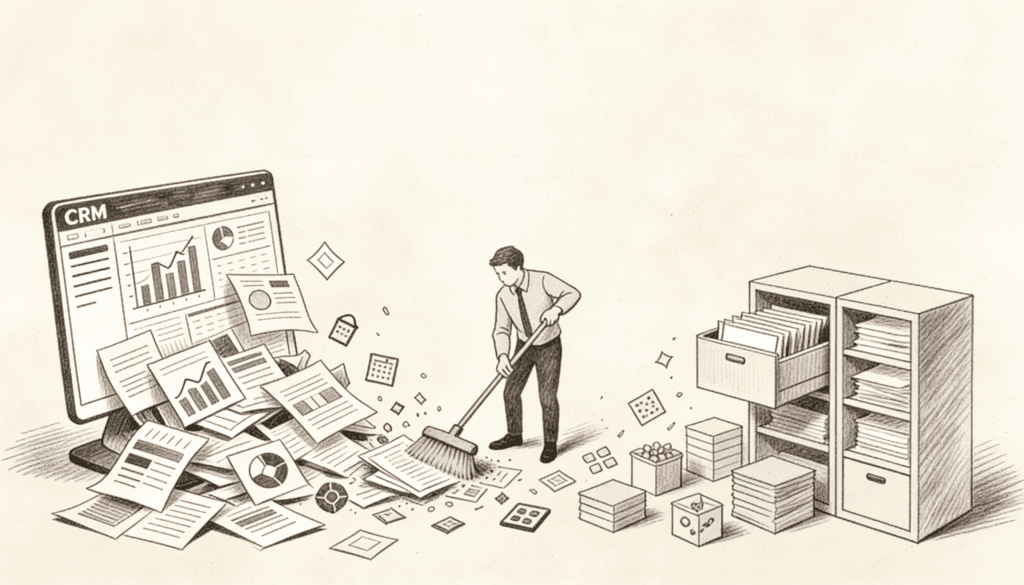
Most companies treat their CRM like a junk drawer. You know the one. That kitchen drawer where batteries live next to rubber bands, expired coupons, and mysterious keys that probably don’t open anything anymore. Everyone tosses things in. Nobody sorts through it. And when you actually need something, you waste fifteen minutes digging through chaos.
The difference is that your junk drawer doesn’t cost you customers.
We’ve been thinking about CRM systems wrong. The conversation always centers on features, integrations, dashboards, and automation capabilities. We obsess over whether to choose Salesforce or HubSpot the way people debate iPhone versus Android. But we’re arguing about the container while ignoring what’s inside it.
Your CRM isn’t failing because you picked the wrong software. It’s failing because nobody is responsible for keeping it clean.
The Myth of the Self-Organizing Database
There’s a beautiful fantasy in the business world that information naturally organizes itself. That if you simply create the fields and set up the workflow, data will flow into its proper place like water finding its level. Companies spend months selecting their CRM, weeks training their team, and then somehow expect the system to maintain itself.
This is roughly equivalent to expecting your garden to weed itself because you bought quality seeds.
The reality is that every CRM degrades from the moment you start using it. A sales rep creates a duplicate contact because searching took too long. Someone uses “Inc” in one entry and “Incorporated” in another. A marketing campaign imports five thousand leads with incomplete information. An integration breaks silently and starts filling fields with garbage data. Each tiny mess compounds until you’re making business decisions based on a database that’s thirty percent accurate on a good day.
The psychology here is fascinating. We’ve accepted that physical spaces need regular cleaning. Nobody questions the need for janitorial staff in an office building. Yet we treat digital spaces as if entropy doesn’t apply to them. As if mess only exists in the physical realm.
But information entropy is real, and it’s expensive.
What Admins Actually Do
Most CRM admins spend their time reacting. They reset passwords, adjust permissions, troubleshoot integrations, and create new fields when someone requests them. They’re firefighters, not architects. They’re certainly not janitors.
This isn’t a criticism of admins. They’re doing exactly what their job title suggests. Administering. Managing the system’s operations. But nobody is managing its hygiene.
The distinction matters more than it seems. An admin ensures the CRM functions. A Chief Cleaning Officer ensures it remains useful. One keeps the lights on. The other makes sure you can actually see what the lights are illuminating.
Think about what cleaning actually means in a CRM context. It means identifying and merging duplicate records. Standardizing data formats. Purging outdated information. Enriching incomplete records. Establishing and enforcing naming conventions. Monitoring data quality metrics. Creating feedback loops so bad data gets caught at entry, not after it poisons your reports.
This is specialized work. It requires understanding both the technical architecture and the business processes that generate the data. You need someone who thinks about information like a librarian thinks about books, not like a plumber thinks about pipes.
The Compounding Cost of Dirty Data
Here’s where things get interesting from an economic perspective. Clean data has increasing returns. Dirty data has accelerating costs.
When your CRM is clean, every new piece of information makes it more valuable. Sales people trust it, so they use it, so they update it, so it becomes more trustworthy. Marketing can segment accurately. Leadership can forecast reliably. The system becomes a flywheel.
When your CRM is dirty, every new piece of information makes it less valuable. Sales people stop trusting it, so they stop using it, so they create shadow spreadsheets, so the CRM becomes even less reliable. Marketing sends campaigns to the wrong people. Leadership makes decisions on fiction. The system becomes a death spiral.
The middle ground doesn’t exist. You’re either trending toward order or toward chaos. There’s no steady state because your business keeps changing, your team keeps growing, and your market keeps evolving. Without active maintenance, the default direction is always toward entropy.
Most companies don’t notice this happening because degradation is gradual. It’s like gaining weight slowly versus waking up twenty pounds heavier overnight. If the latter happened, you’d take immediate action. The former lets you rationalize and delay.
But here’s the cruel part. The longer you wait to clean your CRM, the harder it becomes. Not linearly harder. Exponentially harder. Because dirty data breeds more dirty data. A duplicate contact gets referenced in opportunities, emails, support tickets, and marketing campaigns. Now you can’t just delete it. You have to untangle it from a dozen other records. What would have taken five minutes to prevent now takes an hour to fix.
The Invisible Work Problem
Part of why CRM cleaning doesn’t happen is that it’s invisible work. When someone cleans your CRM, nothing dramatic changes. The system doesn’t suddenly look different. There’s no ribbon cutting ceremony for merged duplicates.
This connects to a broader pattern in how we value work. Visible creation gets rewarded. Invisible maintenance gets ignored. We celebrate the person who builds the house, not the person who keeps it standing for fifty years. We promote the executive who launches new initiatives, not the one who makes existing operations run smoothly.
Cleaning is maintenance. And maintenance is the most underrated function in business.
Consider what happens when maintenance fails in other domains. Buildings collapse. Bridges fall. Machines break. Software becomes unusable. Yet we act surprised when our unmaintained database becomes unreliable.
The irony is that prevention is not only cheaper than cure, it’s also less disruptive. Spending an hour each week cleaning your CRM means you never need to spend a month doing a complete data overhaul. But month-long projects get budget approval and executive attention. Weekly maintenance gets defunded because it’s not urgent.
Urgency and importance rarely align. The urgent drives out the important until the important becomes urgent through crisis. Then we act shocked and look for someone to blame.
What a Chief Cleaning Officer Actually Does
Let’s get specific about what this role entails, because the title might sound whimsical but the function is deadly serious.
A Chief Cleaning Officer establishes data standards. This means deciding how names get formatted, how companies get categorized, what information is required versus optional, and what valid entries look like for each field. This isn’t about being pedantic. It’s about making future searching and sorting possible.
They audit data quality regularly. Not when someone complains, not when a report looks wrong, but on a schedule. They run queries to find duplicates, incomplete records, orphaned data, and statistical anomalies. They catch problems before they metastasize.
They design and enforce data entry protocols. This means creating clear guidelines for the team, building validation rules into the system, and providing training on why data quality matters. People comply with standards when they understand the reason, not just the rule.
They collaborate with every team that touches the CRM. Sales, marketing, customer success, finance, operations. Each team creates data differently and needs data differently. The Chief Cleaning Officer sits at the intersection, understanding how information flows through the organization and ensuring that flow doesn’t create pollution.
They measure and report on data health. Not in a finger-pointing way, but in a diagnostic way. What percentage of contacts have complete information? How many duplicates were created this month? Where are the biggest quality gaps? These metrics make the invisible visible and create accountability for improvement.
Crucially, they also make decisions about data deletion. Every CRM accumulates dead weight. Old contacts who never converted. Past customers who aren’t coming back. Leads from campaigns that failed. Keeping everything forever doesn’t make you thorough. It makes your database slow and your insights muddy. A good Chief Cleaning Officer knows when to let go.
The Strategic Dimension
Here’s where this role transcends cleaning and becomes strategic. The person who deeply understands your CRM data can see patterns nobody else sees. They notice that your best customers all have a particular characteristic. They spot that a specific lead source consistently produces junk. They identify that your sales team is spending time on opportunities that never close.
This is intelligence work. Not in the spy sense, but in the sense of extracting understanding from information. And you can’t do that with dirty data any more than you can do chemistry with contaminated samples.
Companies spend fortunes on business intelligence tools and data analysts. But if the underlying data is garbage, you’re just analyzing garbage faster. You’re polishing a turd, to use the technical term.
The Chief Cleaning Officer makes your other data investments actually work. They’re not competing with your analysts. They’re enabling them. It’s the difference between trying to paint on a dirty canvas versus a clean one. Same paint, same technique, completely different outcome.
There’s also a customer experience dimension here that companies miss. When your CRM is clean, customers don’t get duplicate emails. They don’t receive irrelevant campaigns. They don’t have to explain their situation again because the rep actually has accurate notes. Clean data creates seamless experiences. Dirty data creates friction and frustration.
Your customers can’t see your CRM, but they can feel it. Every interaction either confirms that you know them or reveals that you don’t. In an era where personalization is table stakes, dirty data is a competitive disadvantage.
Why This Isn’t Just Another Task for Existing Roles
The natural response to this argument is that CRM cleaning should just be distributed among existing roles. Admins can do some, sales ops can do some, each team can clean their own data.
This fails for the same reason that asking everyone to clean the office fails. It’s everyone’s responsibility, which means it’s nobody’s responsibility. Diffuse accountability produces no accountability.
Moreover, effective cleaning requires a holistic view. If marketing cleans their leads without coordinating with sales, you get inconsistencies. If sales cleans their opportunities without coordinating with customer success, you get gaps. Distributed cleaning becomes distributed chaos.
The other argument is that automation will solve this. AI will deduplicate records, enrichment tools will fill in missing data, and validation rules will prevent bad entries. Technology will make human cleaning unnecessary.
This is like saying that dishwashers eliminate the need to ever wash dishes by hand. Yes, automation helps. But it doesn’t eliminate the need for judgment, oversight, and maintenance. Automation can find potential duplicates, but a human needs to decide which to keep. Tools can suggest data standardization, but someone needs to set the standards. Technology is a lever, not a replacement.
And frankly, the more automated your CRM becomes, the more important cleaning becomes. Because automated processes propagate errors at scale. A human making a data entry mistake creates one bad record. An automated workflow making the same mistake creates thousands. Without someone actively monitoring quality, automation becomes a weapon of mass data destruction.
The Cultural Shift
Implementing a Chief Cleaning Officer role requires changing how your company thinks about data. It means accepting that information is a living thing that requires care, not a static asset you acquire once.
This is genuinely hard. It requires investing resources in something that doesn’t directly generate revenue. It means prioritizing long term health over short term speed. It demands discipline in an era that rewards hustle.
But here’s the thing about discipline. It’s what separates professionals from amateurs. Amateurs practice until they get it right. Professionals practice until they can’t get it wrong. The same principle applies to data. Amateur organizations tolerate messy data until it causes a crisis. Professional organizations maintain clean data so crises don’t happen.
The companies that figure this out will have a significant advantage. Not because their CRM software is better, but because the information inside it is trustworthy. They’ll make better decisions, move faster, and serve customers more effectively. Not through genius strategy, but through operational excellence.
And operational excellence is just a fancy term for doing the basics consistently well. Including the basic of keeping your database clean.
Making the Case
If you’re trying to justify this role to leadership, focus on time waste and opportunity cost. Calculate how many hours your team spends searching for information, fixing errors, or working around bad data. Multiply that by labor cost. That’s your baseline.
Then consider the invisible costs. Deals lost because the sales rep didn’t have accurate contact information. Campaigns that failed because you targeted the wrong audience. Forecasts that missed because the pipeline data was wrong. Strategic decisions made on faulty information.
You don’t need to quantify these precisely. You just need to make them concrete. Help leadership see that dirty data isn’t a technical problem. It’s a business problem wearing a technical disguise.
The investment in a Chief Cleaning Officer pays for itself quickly. Not in some abstract future, but in immediate improvements to how work actually gets done. Your team spends less time fighting the CRM and more time using it. Your reports become reliable. Your customer interactions improve.
This isn’t about perfection. Your CRM will never be perfectly clean. Perfection is expensive and probably unnecessary. But there’s a massive difference between seventy percent data accuracy and ninety five percent. That gap is the difference between a tool you tolerate and a tool you trust.
The Bottom Line
Your CRM is probably the second or third most expensive software investment your company makes after payroll systems. You’re paying for it every month. Your team is using it every day. Your business depends on the information inside it.
So why would you treat it like a junk drawer?
The role doesn’t have to be called Chief Cleaning Officer. Call it Director of Data Quality, CRM Steward, or Information Hygiene Manager if you prefer. The title matters less than the function.
What matters is that someone wakes up every morning thinking about the health of your database. Someone who sees data quality as their primary responsibility, not an afterthought. Someone who has the authority, resources, and mandate to keep your most valuable business asset actually valuable.
Because here’s the uncomfortable truth. You already have someone doing this job. They’re just doing it badly because it’s split across twenty people who each spend five percent of their time on it. You’re paying for the role through inefficiency and error. You’re just not getting the benefits of actually doing it right.
The question isn’t whether you need a Chief Cleaning Officer. It’s whether you’re ready to admit it.