Table of Contents
The sales floor operates on a peculiar logic. A number appears on a dashboard, and suddenly grown professionals begin behaving like teenagers chasing high scores in a video arcade. They refresh their metrics obsessively. They celebrate arbitrary milestones. They develop elaborate rituals around pipeline reviews. The question isn’t whether quotas change behavior. They obviously do. The question is whether they’re creating a game worth playing or just an exhausting treadmill dressed up in cheerful colors.
Traditional thinking treats quotas as straightforward motivation devices. Set a target, attach a reward, watch performance improve. This framework assumes humans are basically simple machines responding to inputs. Push the right button, get the desired output. Reality suggests something more complicated. The same quota structure that energizes one team can demoralize another. The same gamification elements that spark creativity in some contexts create perverse incentives in others. Understanding why requires looking past the surface mechanics into how people actually experience the systems we build around them.
The Seduction of Points
Gamification sounds harmless enough. Add some badges, create a leaderboard, maybe throw in some achievement unlocks. The vocabulary borrows from entertainment, which makes it feel lighter than traditional management speak about targets and performance metrics. But calling something a game doesn’t necessarily make it fun. It just makes it measured differently.
The psychology here is genuinely interesting. Games work because they create clear feedback loops. You do something, you see the result, you adjust your approach. This immediacy matters more than most people realize. Traditional quota systems often suffer from lag time. You make a call in January, the deal closes in March, you get paid in April. The connection between action and outcome stretches thin. Gamification attempts to solve this by creating intermediate rewards. Every activity gets recognized. Every small win gets celebrated.
Except behaviors don’t exist in isolation. When you start rewarding dials made or meetings booked, you’re not just encouraging those activities. You’re also communicating what matters. And people read these signals with remarkable accuracy. If the scoreboard emphasizes activity over outcome, activity is what you’ll get. The system might generate impressive numbers for calls made while actual revenue stays flat. This isn’t because salespeople are lazy or stupid. It’s because they’re doing exactly what the measurement system tells them to do.
The best game designers understand something important about motivation. Points only matter if they represent something meaningful. Arbitrary achievements feel hollow. This is why mobile games constantly struggle with retention despite increasingly sophisticated reward mechanisms. Players eventually realize they’re just pushing buttons for digital confetti. The parallel to sales organizations should be obvious but somehow isn’t. We keep adding more metrics, more dashboards, more gamified elements, then wonder why engagement drops.
When Grinding Becomes The Game
There’s a concept in gaming called grinding. It refers to repetitive tasks players complete not because they’re enjoyable but because they’re necessary to progress. Kill a thousand monsters to level up. Collect a hundred items to unlock the next area. The activity itself provides no intrinsic satisfaction. It’s purely instrumental. A means to an end.
Sales quotas can drift into this territory almost accidentally. The structure starts sensibly enough. Set targets that stretch but don’t break. Create predictable paths to success. Reward consistent effort. But markets shift. Competition intensifies. What once felt achievable starts feeling arbitrary. The gap between effort and outcome widens. Suddenly you’re grinding, not playing.
The behavioral signature of grinding is distinct. People still show up. They still complete the required activities. But the energy changes. Tasks get checked off mechanically. Creativity disappears. Risk aversion increases. Nobody experiments with new approaches because experimentation might hurt the numbers. The safer move is to just keep doing what’s expected, even when it clearly isn’t working. This is how entire organizations can be busy and productive while simultaneously stagnating.
What makes this particularly insidious is that grinding can look like commitment. Leaders see teams working hard, hitting activity metrics, maintaining effort. The system appears functional. But underneath, people are just enduring until something changes. They’ve learned the quota is a hurdle to clear, not a challenge to embrace. The distinction matters enormously for long term performance.
The Analytics Trap
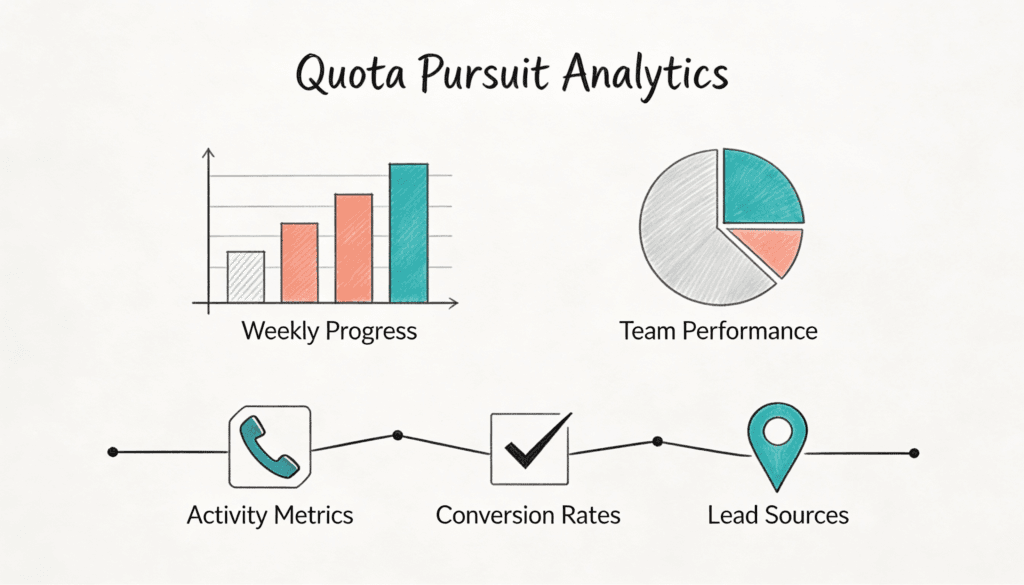
Modern tools make it possible to measure everything. Time spent on calls. Email open rates. Demo completion percentages. Proposal response rates. Each metric gets its own dashboard, its own target, its own place in the compensation plan. The assumption is that more data creates more clarity. Better analytics lead to better decisions.
Except human behavior is stubborn about refusing to be optimized. When everything gets measured, people start optimizing for the measurements rather than the underlying goals. This isn’t malicious. It’s just rational. If my performance review depends on maintaining a certain number of touches per prospect, I’ll make sure to hit that number. Whether those touches actually advance opportunities becomes secondary.
The analytics trap reveals itself in fascinating ways. Teams develop elaborate techniques for gaming their metrics without technically cheating. Emails get sent at optimal times for open rates but terrible times for actual reading. Calls get logged as completed even when they lasted thirty seconds. Meetings get scheduled further out to keep them in the pipeline counts. None of this involves lying. It’s just responding sensibly to the incentive structure.
The deeper problem is that measurement itself changes the thing being measured. This isn’t some abstract philosophical point. It’s a practical reality that organizations ignore at their peril. The moment you tell people that a specific metric matters for their compensation, that metric stops being a neutral indicator and becomes a target to hit. And once metrics become targets, they stop being useful measures of actual performance.
The Quota As Narrative Device
Here’s where things get interesting. Quotas don’t just measure performance. They tell a story about what success looks like. Every organization has a quota structure that communicates values whether leaders realize it or not. A system heavily weighted toward new customer acquisition says something different than one emphasizing expansion in existing accounts. A structure that pays the same for small and large deals sends a different message than tiered commissions.
People respond to these narratives. They use them to understand their role, to evaluate their efforts, to decide what deserves attention. A quota system is essentially asking: what does winning look like here? And the answer shapes behavior in ways that extend far beyond the specific metrics being tracked.
The most effective systems understand this narrative dimension. They don’t just set numbers. They create contexts where those numbers make sense as part of a larger mission. The quota becomes a milestone in a journey, not just an arbitrary target. This might sound like motivational fluff, but the behavioral differences are measurable. When people understand how their individual targets connect to broader objectives, they make different choices about where to invest effort.
Consider two identical quota structures in different companies. One frames targets as minimum expectations that everyone should meet. The other frames them as stretch goals that represent exceptional performance. Same numbers, completely different psychological contexts. The first creates anxiety around falling short. The second creates excitement around exceeding. These emotional tones matter enormously for sustained performance.
The Social Architecture Of Competition
Leaderboards are the most visible gamification element in most sales organizations. Rankings get published. Top performers get recognized. The assumption is that visibility drives competition, which drives effort. And sometimes it does. But the social dynamics of ranked performance are more complex than simple motivation theory suggests.
Public rankings create winners and losers by definition. This seems obvious but the implications ripple out in unexpected ways. For people near the top, leaderboards can be energizing. They’re in the game. They have a shot. But for people in the middle or bottom, the same leaderboard can be demoralizing. It’s a constant reminder that others are succeeding where they’re not. And demoralized people don’t suddenly start performing better because you showed them how far behind they are.
There’s also the question of what competition does to collaboration. Sales might seem like an individual sport, but successful organizations require tremendous cooperation. People need to share insights, refer leads, help each other solve problems. Anything that intensifies individual competition tends to reduce collective support. The optimal structure probably creates enough competitive pressure to drive effort without so much that people stop helping each other succeed.
Beyond The Number
The most sophisticated approach to quota design treats them as one element in a larger system rather than the system itself. Numbers matter, obviously. Revenue targets serve real functions. But they work best when embedded in contexts that address the full range of factors affecting performance.
This means thinking about quotas alongside coaching quality, market conditions, product capabilities, and organizational support. A salesperson might miss their number because they’re not trying hard enough. Or because their territory got reassigned. Or because the product has a critical gap. Or because they never received proper training. Treating the quota as the sole diagnostic tool for performance misses most of what’s actually happening.
The behavioral analytics worth paying attention to aren’t just conversion rates and activity metrics. They’re patterns that reveal how people experience their work. Are top performers sharing techniques or hoarding advantages? Do people in the middle of the pack seem engaged or resigned? Is there experimentation happening or just repetition of proven approaches? These qualitative signals matter as much as quantitative metrics for understanding organizational health.
Smart leaders use quota performance as a starting point for conversation rather than an ending point for judgment. The number someone hits matters less than understanding why they hit it. What worked? What didn’t? What got easier? What got harder? This transforms quotas from blunt evaluation tools into learning opportunities. The goal isn’t just to measure performance but to understand it well enough to improve it systematically.
The Human Element
All of this analysis risks losing sight of something fundamental. Quota pursuit happens inside human minds with human emotions. People care about hitting their numbers not just because of compensation but because of identity. Professional pride matters. The desire to contribute matters. Fear of failure matters. These psychological dimensions aren’t separate from the analytical framework. They’re central to it.
The difference between gamification and grinding often comes down to agency. Do people feel like active participants shaping their outcomes or passive recipients of arbitrary demands? The actual quota level might matter less than whether people believe they have meaningful control over results. Systems that create learned helplessness, where effort feels disconnected from outcome, generate grinding. Systems that reinforce the connection between action and result create engagement.
This suggests that the most important metric might not be quota attainment at all. It might be something harder to measure but more fundamental: do people believe the game is fair? Do they trust that effort will be rewarded? Do they see the system as designed to help them succeed or just to extract maximum output? These questions determine whether quota pursuit feels like a challenge worth accepting or just an obligation to endure.
The organizations getting this right aren’t necessarily the ones with the most sophisticated analytics or the cleverest gamification elements. They’re the ones that treat quotas as tools for alignment rather than weapons for motivation. They create transparency around how targets get set. They adjust for changing conditions. They celebrate progress while acknowledging difficulty. They remember that behind every number is a person trying to do something hard, and that person deserves a system designed to help them succeed rather than just measure whether they did.
Pingback: The CRM Snitch: Using Analytics to Identify Your Most Toxic Sales Reps