Table of Contents
Most companies treat their CRM like a filing cabinet. They stuff it with contact information, track activities, and generate reports. Then they wonder why growth feels like pushing a boulder uphill. The problem isn’t the system. It’s the thinking.
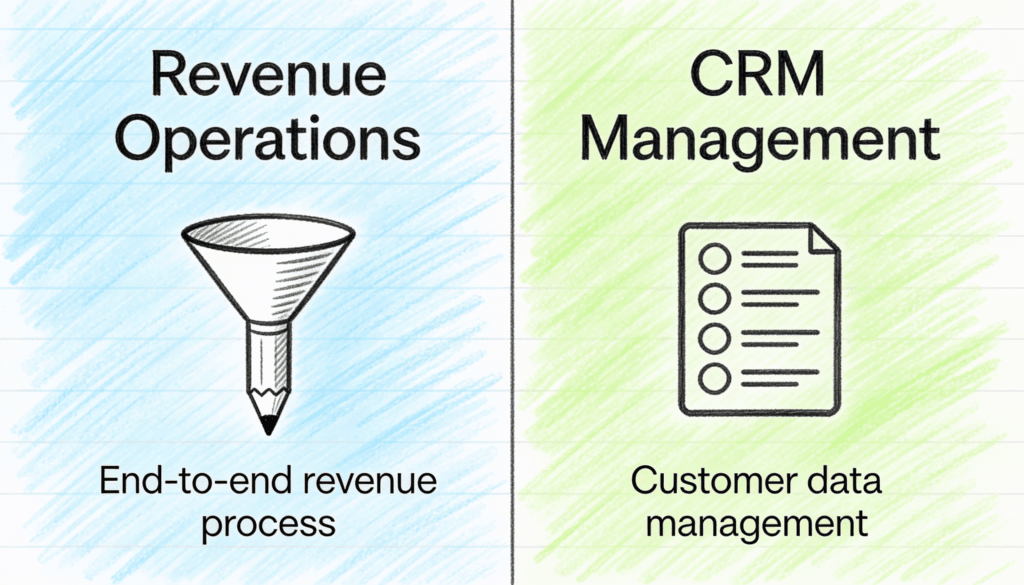
CRM management operates within boundaries. Revenue Operations tears down those boundaries and asks a more dangerous question: what if the way we’ve organized work is actually preventing revenue?
The Illusion of Completeness
A well-managed CRM gives you a sense of control. Your sales team logs calls. Marketing tracks campaigns. Customer success monitors renewals. Everything has its place. But this orderly world hides a fundamental flaw.
Consider how a hospital works. The cardiologist knows hearts. The neurologist knows brains. Each specialist excels within their domain. But what happens when a patient’s symptoms don’t fit neatly into one category? The system that creates expertise also creates blindness.
CRM management is specialist thinking applied to revenue. Sales owns the CRM. Marketing has their automation platform. Customer success has their ticketing system. Finance has their spreadsheets. Each team optimizes their piece of the puzzle. Nobody optimizes the puzzle itself.
Revenue Operations emerged because companies finally noticed something obvious: customers don’t experience your org chart. They experience one company. When sales promises a feature that product hasn’t built, when marketing generates leads that sales ignores, when success teams lack visibility into the sales process, that’s not a technology problem. It’s an architecture problem.
From Record Keeping to Revenue Architecture
The shift from CRM management to Revenue Operations resembles the shift from bookkeeping to financial strategy. Both are necessary. Neither is sufficient.
A bookkeeper records transactions accurately. A financial strategist asks why those transactions happened and what they reveal about future possibilities. CRM management maintains data hygiene and process compliance. Revenue Operations designs the system that determines which data matters and why.
Here’s where it gets interesting. Most revenue problems look like execution problems. Sales isn’t closing enough deals. Marketing isn’t generating enough leads. Customer success isn’t preventing churn. So companies hire better salespeople, demand more leads, and implement retention programs. They’re solving the wrong problem.
The real problem is structural. Your sales cycle is too long not because your salespeople are slow but because eight different people need to approve a decision and nobody designed that process intentionally. Your marketing qualified leads convert poorly not because marketing is bad at their job but because sales and marketing defined qualified differently and never reconciled those definitions. Your customers churn not because your product disappoints but because the experience they were sold doesn’t match the experience they receive.
Revenue Operations looks at these problems and sees something that CRM management misses: the system itself generates the outcomes. Change the system, change the outcomes.
The Geography of Revenue
Think about how cities develop. In the beginning, everyone lives near the water source. As the city grows, neighborhoods form. Each develops its own character, its own rules, its own identity. Eventually, commuting between neighborhoods becomes so painful that people stop visiting each other. The city becomes a collection of isolated villages.
This is what happens inside companies. Sales, marketing, and customer success start as one small team sharing one goal. As the company grows, each function develops its own culture, its own metrics, its own interpretation of success. The CRM becomes the border between territories.
CRM management accepts these borders. It tries to make each territory function better. Revenue Operations questions whether the borders should exist at all.
Consider the concept of a lead. Marketing generates leads. Sales qualifies them. Simple enough. But watch what actually happens. Marketing optimizes for volume because they’re measured on lead quantity. Sales optimizes for quality because they’re measured on closed deals. Marketing accuses sales of not following up. Sales accuses marketing of sending garbage. Both are right. Both are optimizing locally while destroying value globally.
Revenue Operations doesn’t just manage this tension. It redesigns the question. Instead of asking how many leads marketing should generate, it asks what signals actually predict revenue. Instead of measuring marketing and sales separately, it measures the entire conversion engine. Instead of optimizing handoffs, it eliminates them.
The Data Theater Problem
Here’s an uncomfortable truth: most companies are drowning in data but starving for insight.
Your CRM contains thousands of data points. Fields for everything. Dashboards for everyone. Reports that take hours to generate and minutes to ignore. This is data theater. It looks like analysis. It feels like progress. It produces nothing.
CRM management treats data as the goal. Revenue Operations treats data as a tool. The difference matters more than it seems.
When data is the goal, you measure what’s easy to measure. Activities logged. Emails sent. Calls made. These metrics reassure executives that work is happening. They don’t reveal whether that work creates value.
When data is a tool, you measure what’s hard to measure. Which activities actually correlate with closed deals? Which customer behaviors predict expansion? Which sales actions prevent churn? These questions require connecting data across systems, analyzing patterns over time, and accepting that some of the most important insights can’t be captured in a dropdown menu.
Revenue Operations treats analytics the way a detective treats evidence. The goal isn’t to collect everything. It’s to collect what matters and understand what it means.
The Speed Problem Nobody Talks About
Speed has become a business obsession. Everyone wants faster sales cycles, faster product launches, faster growth. But speed in the wrong direction is just expensive failure.
CRM management speeds up individual processes. Automate email sequences. Streamline approvals. Reduce clicks. These improvements help. They also miss the point.
Revenue Operations asks a different question: are we doing the right things? A sales process that moves prospects efficiently through six unnecessary steps is still wasting everyone’s time. Marketing automation that sends perfectly timed messages to people who will never buy is still burning money. Customer success playbooks that scale bad practices just create bad experiences faster.
This is why Revenue Operations feels slower at first. You’re not just executing the existing process better. You’re questioning whether the process should exist at all. That requires patience. It also requires courage because the person who questions the process looks like they’re not getting work done.
But here’s the irony. Once you design the right system, execution becomes almost automatic. Sales cycles collapse because you’ve removed the friction. Conversion rates soar because you’ve aligned the experience. Retention improves because customers get what they were promised. You go slow to go fast.
The Accountability Paradox
Traditional organizational design loves clean accountability. Each person owns their number. Each team controls their outcome. This clarity comforts executives. It also guarantees dysfunction.
When sales owns the revenue number, they’ll do anything to hit it. Discount aggressively. Promise features that don’t exist. Close customers who shouldn’t buy. They’re not being malicious. They’re being rational. You designed a system that rewards this behavior.
When marketing owns the lead number, they’ll generate leads however they can. Broaden targeting. Lower qualification standards. Count the same person multiple times. Again, not malicious. Rational.
Revenue Operations dissolves these perverse incentives by dissolving the boundaries that create them. Instead of sales, marketing, and customer success each owning separate outcomes, the entire revenue organization owns one outcome: sustainable revenue growth.
This shared accountability sounds soft until you realize how powerful it becomes. Sales can’t just chase any deal. The deal has to fit what customer success can deliver. Marketing can’t just generate any lead. The lead has to match what sales can close and success can retain. Customer success can’t just prevent churn. They have to create expansion opportunities that sales can capture.
Suddenly everyone’s job is to make everyone else’s job easier. That’s not a cultural initiative. It’s a structural outcome.
The Invisibility of Good Operations
Great Revenue Operations becomes invisible. The sales process feels natural. Marketing and sales seem to communicate telepathically. Customers get what they expect. Everything just works.
This invisibility creates a political problem. CRM management produces visible artifacts. Clean data. Accurate reports. Smooth deployments. Everyone can see the work. Revenue Operations produces better outcomes. When outcomes improve, everyone takes credit. When Revenue Operations does its job perfectly, nobody notices it did anything.
This is why so many companies still organize around CRM management. Visible work feels safer. Invisible work requires faith. Most executives struggle with faith when quarterly numbers loom.
But consider what happens in a recession or during explosive growth. Companies with great CRM management survive. Companies with great Revenue Operations thrive. The difference is that one manages the present efficiently. The other architects the future intentionally.
What This Means For You
If you’re reading this as someone who manages a CRM, you might feel defensive. You shouldn’t. CRM management isn’t obsolete. It’s insufficient. You can maintain perfect data hygiene while your company bleeds revenue. You can build flawless reports while competitors build better systems.
The shift to Revenue Operations doesn’t eliminate the need for operational excellence. It elevates what operational excellence means. Instead of perfect execution of existing processes, it demands perfect design of the right processes.
If you’re reading this as a leader frustrated by growth that’s harder than it should be, by systems that fight each other, by teams that optimize locally while destroying value globally, you’re experiencing what happens when 20th century organizational design meets 21st century complexity.
Revenue Operations isn’t a trend. It’s a recognition that the game changed. Customers move between your website, your product, your support team, and your sales team fluidly. Your organization needs to match that fluidity. CRM management can’t deliver this. It was never designed to.
The strategic shift isn’t about buying new software or changing titles. It’s about accepting that sustainable revenue requires intentional design across the entire customer lifecycle. It requires dissolving boundaries that create local optimization but global dysfunction. It requires treating data as insight rather than inventory.
Most importantly, it requires recognizing that how you organize work determines what work produces. You can have the best CRM, the best people, and the best processes within each function while still building a system that makes revenue growth unnecessarily hard.
Revenue Operations is the discipline of making growth easier by making the system smarter. Everything else is just very organized chaos.