Table of Contents
Most businesses are hunting for new customers while their best opportunities are already in their database, probably checking their spam folder for that generic email blast you just sent.
The marketing world suffers from a peculiar blindness. We obsess over acquisition costs, conversion rates, and landing page optimization. Meanwhile, the customers who already bought from us get treated like strangers at a family reunion. Same promotional email. Same discount code. Same everything.
This is where RFM segmentation becomes less of a technical framework and more of a philosophical correction. It forces us to acknowledge that not all customers are equal, which sounds obvious until you look at how most companies actually communicate with their lists.
The Intelligence Already Living in Your Data
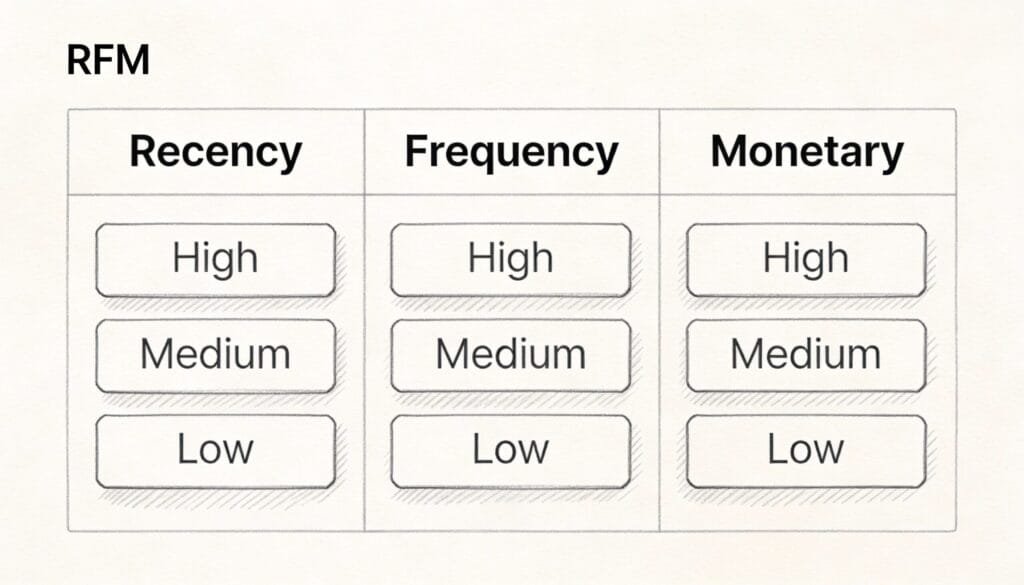
RFM stands for Recency, Frequency, and Monetary value. Three simple dimensions that reveal everything you need to know about customer behavior without requiring a PhD in data science or expensive predictive analytics software.
Recency tells you who engaged with you recently. These people remember you. They know what you sell. The relationship is warm. Frequency shows you who comes back. These are your fans, your repeat believers, the ones who actually trust you. Monetary value identifies who spends money with you, not who just browses or subscribes to your newsletter for the free guide they’ll never read.
Put these three together and you have a map of human behavior that’s more accurate than most personality tests. You can see loyalty before someone consciously decides to be loyal. You can spot the beginning of customer abandonment before they ghost you completely.
The beauty here is that RFM doesn’t care about demographics or psychographics or any of the elaborate persona documents gathering dust in your shared drive. It cares about what people actually do. And what people do is far more honest than what they say they’ll do.
Why Most Segmentation Fails
Traditional segmentation typically involves sorting customers by age, location, job title, or some behavioral trigger like cart abandonment. These approaches aren’t wrong. They’re just incomplete.
Imagine treating all 35 year old women from Chicago the same way. One bought from you yesterday and has purchased seven times this year. Another bought once three years ago and never opened another email. According to demographic segmentation, they’re identical. According to reality, they might as well be from different planets.
The problem with most segmentation is that it’s either too broad or too complicated. Broad segmentation treats thousands of people the same way. Complex segmentation requires so much data integration and technical infrastructure that by the time you’re ready to act, the moment has passed.
RFM sits in that sweet spot. It’s sophisticated enough to be useful but simple enough to implement without hiring a data engineering team.
The Counterintuitive Truth About Your Best Customers
Here’s something that trips up most businesses. Your highest spending customers aren’t always your most valuable customers.
Someone who spent five thousand dollars with you two years ago and disappeared is less valuable than someone who spent five hundred dollars last month and keeps coming back. The big spender gave you a great month. The consistent buyer is giving you a business.
This is where recency and frequency create a more complete picture than monetary value alone. A customer who buys often, even in small amounts, is showing you something important. They’re integrating your product into their life. They’re forming a habit around you.
These customers are also your best source of feedback, your most likely referrers, and your safest bet for trying new products. They’ve already decided you’re trustworthy. That decision is incredibly valuable and often underpriced.
The Segments That Actually Matter
When you layer recency, frequency, and monetary value together, distinct groups emerge. Not arbitrary groups you invented in a strategy meeting, but groups that form naturally based on behavior.
Your Champions bought recently, buy frequently, and spend the most. These people are actively in love with what you do. They’re also the ones most likely to feel ignored if you treat them like everyone else. Send them the same discount as someone who bought once two years ago and you’re essentially telling them their loyalty means nothing.
Your Potential Loyalists bought recently and spent decent money but haven’t established frequency yet. They’re considering whether to make you part of their regular rotation. This is your most important segment because the next interaction determines whether they become Champions or drift away.
Your At Risk customers used to be Champions but their recency score is dropping. They haven’t bought in a while. Something changed. Maybe a competitor won them over. Maybe their needs shifted. Maybe they’re just busy. The point is, you have a small window to re-engage them before they forget you entirely.
Your Hibernating customers bought a few times, spent some money, but went dormant. They didn’t have a bad experience. They just stopped showing up. These people are winnable but you need a compelling reason for them to come back.
Then you have everyone else. The one time buyers. The bargain hunters. The people who joined your list and never converted. These segments matter too, but they shouldn’t get the same attention as your Champions.
Why This Doubles Revenue
The revenue multiplication happens when you stop giving your best customers reasons to leave and stop wasting money on people who don’t care.
Most businesses do the opposite. They spend heavily on acquisition, barely acknowledge their best customers, and send desperate win back emails to people who were never that interested to begin with. It’s like ignoring your spouse while texting your ex and wondering why your relationship isn’t working.
When you implement RFM, you start making intelligent tradeoffs. You might send your Champions an exclusive product launch or early access to a sale. Not because you’re trying to squeeze more money out of them, but because you’re treating them like the VIPs they actually are.
Your Potential Loyalists get a different message. Maybe a product recommendation based on what they bought. Maybe educational content that helps them get more value. The goal is deepening the relationship, not just pushing for another transaction.
Your At Risk customers need re-engagement. Maybe a personal note asking if everything is okay. Maybe a special offer that acknowledges their history with you. The worst thing you can do here is nothing.
The revenue increase comes from three simultaneous movements. Champions buy more because they’re actually recognized and rewarded. Potential Loyalists convert to Champions at higher rates because you’re nurturing them properly. At Risk customers come back because you noticed they left.
Meanwhile, you stop spending marketing budget on people who fundamentally aren’t interested. Those resources get reallocated to the segments that actually respond.
The Execution Problem
RFM segmentation isn’t new. Retailers have used versions of it for decades. So why isn’t everyone doing this?
Because it requires discipline that most marketing teams lack. It’s easier to send one email to everyone than to create seven different campaigns for seven different segments. It’s easier to run Facebook ads for new customers than to figure out how to make your best customers even better.
There’s also an uncomfortable truth hiding in RFM data. When you actually segment your customers properly, you realize how few Champions you have. Most customer bases look like pyramids. A small group at the top generating most of the value. A huge group at the bottom generating occasional transactions and lots of noise.
This revelation makes some businesses uncomfortable. They’d rather believe all customers are valuable than confront the mathematics of customer lifetime value inequality. But knowing the truth is what allows you to change it.
Starting Simple
The technical implementation of RFM can be as simple or complex as you want. You can calculate scores manually in a spreadsheet or build automated systems that update in real time.
Start by pulling three pieces of data for every customer. When did they last buy? How many times have they bought? How much have they spent in total?
Score each dimension on a scale from one to five. Five means recent, frequent, or high spending. One means the opposite. A customer who scores 555 is a Champion. A customer who scores 111 needs a miracle.
These scores immediately tell you who deserves your attention. They also tell you what kind of attention each segment needs. Champions need recognition. Potential Loyalists need encouragement. At Risk customers need intervention.
The exact scoring methodology matters less than consistently applying it and actually using the segments to change your behavior.
Beyond the Transaction
RFM reveals something deeper than purchase patterns. It shows you relationships in different stages of development.
Your Champions are in a committed relationship with your brand. Your Potential Loyalists are dating you. Your At Risk customers are screening your calls. Your Hibernating customers broke up with you but might reconcile under the right circumstances.
Viewing customers through this relational lens changes how you communicate. You wouldn’t propose marriage on a first date. You wouldn’t ignore your spouse for months then suddenly ask for a favor. Yet businesses make these relationship errors constantly in their marketing.
RFM gives you permission to treat different relationships differently. It removes the guilt of not treating everyone equally because you’re replacing arbitrary equality with earned priority.
The Compound Effect
The real power of RFM isn’t what happens this month. It’s what happens when you consistently allocate resources based on actual customer value for six months, twelve months, three years.
Champions become more valuable because they buy more often and refer others. Potential Loyalists convert at higher rates because you’re not letting them slip away. Your customer acquisition cost drops because referrals increase. Your retention improves because you’re actually paying attention to who’s leaving.
These effects compound over time. A business that implements RFM properly will look fundamentally different three years later. Not because they discovered some growth hack, but because they learned to recognize and amplify what was already working.
Most businesses die from poor resource allocation, not poor product. They spend equally on unequal opportunities. They treat their best assets like their worst ones. They confuse activity with progress.
RFM is the correction. It’s a framework for seeing clearly, deciding wisely, and acting proportionally. Nothing about it is complicated. Everything about it is difficult because it requires acknowledging truths most businesses prefer to ignore.
Your revenue is already in your database. You just have to decide whether you’re going to keep searching for strangers or start appreciating the people who already chose you.