Table of Contents
You know that feeling when you’re so absorbed in something that time disappears? When the work flows through you instead of from you? Athletes call it being in the zone. Psychologists call it flow state. And most companies would pay a fortune to bottle it.
Here’s the strange part: we’ve spent decades studying flow in individuals, but we barely understand it in groups. We know how one programmer gets into flow, but what about an entire engineering team? What about a whole company?
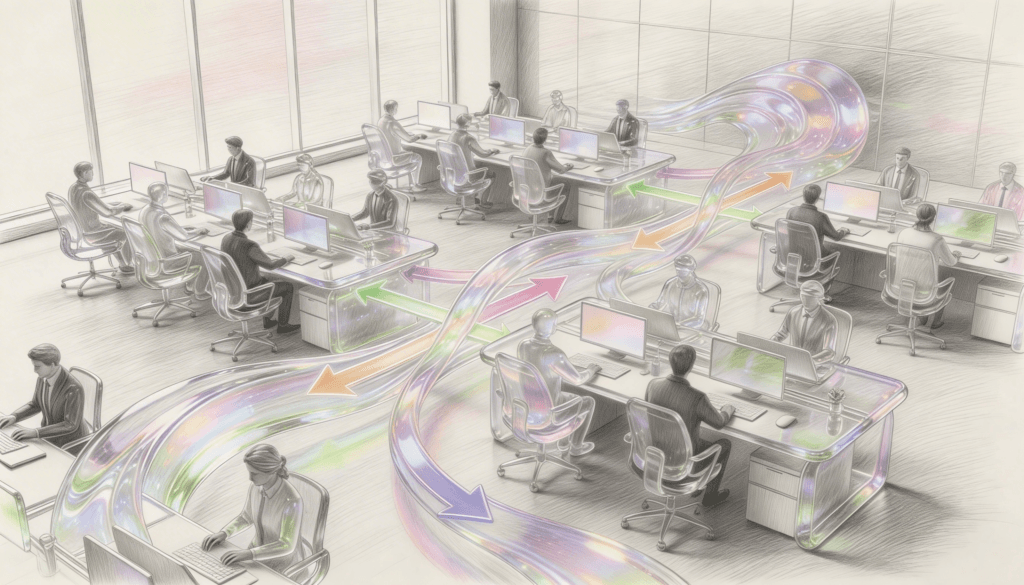
This matters more than you might think. Individual flow is impressive. A single person operating at peak focus can produce remarkable work. But organizational flow, if it exists, would be something else entirely. It would mean hundreds or thousands of people moving together with the same effortless intensity. The implications would reshape how we think about work itself.
The Original Flow
First, let’s establish what we’re actually talking about. Flow state, as defined by psychologist Mihaly Csikszentmihalyi, happens when challenge and skill meet at just the right level. Too easy and you’re bored. Too hard and you’re anxious. Right in the middle, you enter a state of complete absorption.
During flow, self-consciousness vanishes. The inner critic goes quiet. Action and awareness merge. You’re not thinking about what you’re doing. You’re just doing it.
This sounds mystical, but the mechanics are fairly straightforward. Flow requires clear goals, immediate feedback, and a sense of control. When these elements align, the brain shifts into a different mode. Stress hormones decrease. Feel-good neurochemicals like dopamine and norepinephrine increase. The prefrontal cortex, responsible for self-monitoring and doubt, temporarily downregulates.
The result? Peak performance. Studies show people in flow are up to 500% more productive than normal. They’re more creative, learn faster, and produce higher quality work.
For individuals, this is well-documented. But organizations aren’t just collections of individuals. They’re systems. And systems behave differently than their parts.
The Scaling Problem
Imagine trying to get a hundred musicians into individual flow states simultaneously. Now imagine trying to get them to play a symphony together while in those states. See the problem?
Flow requires intense focus on a clear task. But organizations require coordination across many tasks. Flow needs deep immersion without distraction. Organizations need communication, which is inherently distracting. Flow happens when you stop thinking consciously about what you’re doing. Organizations need people to think consciously about how their work affects others.
The conditions that create individual flow actually seem to oppose the conditions necessary for organizational coherence.
Most companies handle this by not handling it at all. They optimize for coordination and accept that flow states will be rare, individual accidents. Team meetings, status updates, approval processes, and all the other mechanisms of organizational life exist to align people. They also guarantee that almost nobody will experience sustained flow.
This creates an odd situation. We know flow is where the best work happens. We also build organizations that make flow nearly impossible. Then we wonder why people feel simultaneously busy and unproductive.
What Collective Flow Might Look Like
But there are exceptions. Watch a great jazz ensemble improvising. Each musician is clearly in flow individually. Yet they’re also creating something coherent together. The saxophonist responds to the drummer who responds to the bassist who responds to the saxophonist. Nobody planned this. Nobody’s coordinating. Yet it works.
Or consider emergency room teams during a crisis. Doctors, nurses, and technicians move in synchronized chaos. Everyone knows what needs to happen. Information flows instantly. Roles shift fluidly. The team isn’t following a script. They’re improvising at high speed with life and death stakes. And somehow it works.
These examples share something interesting. The coordination happens through the work itself, not through external management. The musicians coordinate by listening to each other play. The medical team coordinates by reading the patient and each other’s actions. The feedback is immediate and embedded in the task.
This suggests a possibility. Maybe organizational flow doesn’t require eliminating coordination. Maybe it requires changing how coordination happens.
The Information Architecture of Flow
Think about why meetings kill flow. It’s not just the interruption, though that matters. It’s that meetings separate coordination from execution. You stop doing the work to talk about doing the work. The feedback loop breaks.
Now think about how software developers work when they’re really clicking. They write code, run tests, see results, adjust, repeat. The cycle time from action to feedback might be seconds. When this rhythm gets going, it creates flow. The developer isn’t thinking about coding. They’re thinking in code.
The best development teams extend this. They use tools that make everyone’s work visible in real time. They write tests that instantly show when something breaks. They deploy constantly so feedback from users comes fast. Coordination happens through shared visibility and rapid feedback, not through meetings about what everyone is doing.
This points to something important. Flow at scale might require redesigning information flow. Instead of centralizing coordination through managers and meetings, you distribute it through systems that make work visible and feedback immediate.
The Autonomy Paradox
You might think organizational flow requires everyone moving in lockstep. But the examples that work best involve high autonomy.
Go back to that jazz ensemble. Each musician has enormous freedom in what they play. The coherence emerges from shared context (the same key, tempo, and structure) and continuous mutual adjustment. The ER team works similarly. Roles are clear but execution is improvised based on the situation.
This creates a paradox. Strong organizational flow might require looser organizational control. You need clear constraints (the goal, the context, the standards) but freedom within those constraints.
Most organizations do the opposite. They specify the how in great detail and leave the what somewhat vague. They tell people exactly how to work but aren’t clear on what success looks like. This is precisely backward for flow.
For flow, you need crystal clear goals and immediate feedback on whether you’re achieving them. But you need freedom in execution. When companies flip this, mandating process but leaving outcomes fuzzy, they kill both individual and collective flow.
The Tempo Question
Flow has a rhythm to it. There’s a pace where challenge and skill meet, where feedback comes fast enough to guide but not so fast it overwhelms. This pace varies by person and task, but it always exists.
Organizations have rhythm too. Some move fast, some slow. But here’s the thing: organizational rhythm usually gets set by factors that have nothing to do with flow. Budget cycles, reporting requirements, management preferences, industry norms.
What if you set organizational tempo based on flow instead? What if you asked: what’s the natural cycle time for meaningful feedback in this work? Then built everything else around that?
For some work, meaningful feedback takes months. You’re designing a new product and won’t know if it works until customers use it. For other work, feedback takes minutes. You’re answering customer service tickets and see immediately whether the customer’s happy.
Matching organizational rhythm to work rhythm is harder than it sounds. It means different teams might operate at completely different speeds. It means throwing out the idea that everyone should follow the same calendar, the same meeting schedule, the same review cycle.
But it might be necessary. Flow happens when the pace feels right. When you’re moving too fast or too slow, you fall out of flow. An organization optimized for flow would let pace vary by context.
The Distraction Economics
There’s a brutal economics to organizational flow. Every distraction has a cost, but not all distractions cost the same amount.
Interrupting someone in flow doesn’t just steal the minutes of the interruption. It steals the time to get back into flow, which can be twenty minutes or more. It might steal the rest of the day if they can’t recover the state they were in.
Do the math. If someone gets interrupted every hour and takes twenty minutes to return to flow, they never actually get there. They spend their entire day climbing toward flow and getting knocked back down.
Most organizational communication assumes interruptions are cheap. Got a quick question? Just ask. Need a status update? Just ping them. Want input on something? Pull them into a meeting.
Each interruption makes sense in isolation. The cost to the interrupter is near zero. But the cost to the interrupted person is high. And because these costs are invisible and diffuse, they never get properly accounted for.
An organization serious about flow would need to make these costs explicit. Maybe that means designated no-interruption blocks. Maybe it means communication tools that batch messages. Maybe it means cultural norms where interrupting someone is seen as expensive and done sparingly.
Whatever the solution, it requires acknowledging that attention is not an unlimited resource and that some ways of spending it destroy far more value than they create.
The Real Question
Here’s what we’re really asking: can an organization be more than the sum of its parts without becoming less than the sum of its parts?
Traditional organizational design assumes coordination requires overhead. To make a thousand people work together, you need managers and meetings and processes. These things slow individuals down but speed the organization up. The tradeoff seems inevitable.
Flow-based organization suggests something different. What if the right design actually made both individuals and the organization faster? What if coordination could happen through the work itself, through visibility and feedback, rather than through external management?
This would require rethinking almost everything about how we structure work. Teams, roles, communication, planning, measurement. It would mean accepting more variance, less predictability, more emergence.
Most executives would find this terrifying. And maybe they should. An organization in flow is powerful but hard to steer. It has momentum. Once it’s moving, changing direction becomes difficult.
But for companies willing to try, the potential is remarkable. Imagine an organization where people regularly experience their best work. Where coordination feels effortless. Where the collective is genuinely smarter and faster than the individuals within it.
What we do know is that our current approach isn’t working. We’ve built organizations that make it nearly impossible for people to do their best work. We’ve optimized for control at the cost of effectiveness. We’ve created systems that are reliable but slow, predictable but mediocre.
Maybe it’s time to try optimizing for something else. Not for control, but for flow. Not for predictability, but for performance. Not for managing people, but for unleashing them.
The zone might be closer than we think.