Table of Contents
Most companies obsess over making customers happy. They measure satisfaction scores, track Net Promoter ratings, and celebrate when people say nice things about their products. Meanwhile, the most profitable businesses in the world have quietly discovered something more valuable than satisfaction: they’ve learned to make themselves irreplaceable.
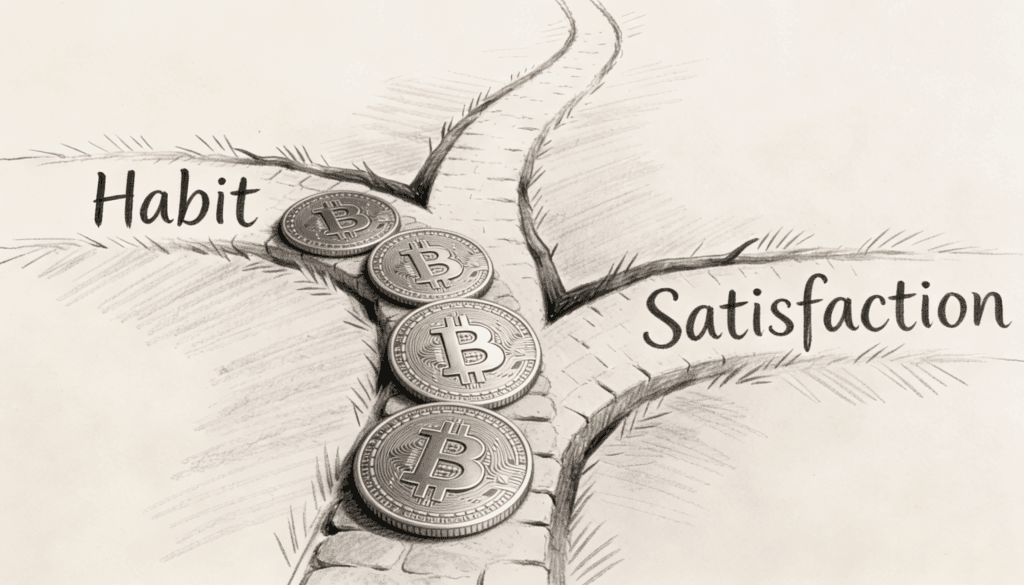
The difference matters more than most strategists realize. Satisfaction is a feeling. Habit is a structure. One lives in the mind as an opinion that can change with the next disappointing interaction. The other embeds itself into the architecture of how someone lives or works, creating friction around every exit.
Consider your email provider. Are you satisfied with it? Probably not entirely. The interface annoys you, the spam filter fails you, and the storage limits frustrate you. Yet you stay. You stay because your entire professional identity is tied to that address. Your contacts know it, your subscriptions use it, and changing it means updating dozen of services while risking missed messages during the transition. The switching cost isn’t about money. It’s about the exhausting prospect of uprooting something woven into your daily existence.
This is where the profit lives. Not in making people happy, but in making departure painful.
The Satisfaction Trap
Customer satisfaction emerged as a business metric because it seemed logical. Happy customers should be loyal customers. Loyal customers should be profitable customers. The reasoning follows a neat line from emotion to economics.
The problem is that satisfaction measures a moment. It captures how someone feels after an interaction or during a survey. But purchasing decisions happen in a different space entirely. They happen when someone weighs the full cost of change against the full cost of staying, including all the invisible costs that satisfaction surveys never capture.
A customer might feel satisfied with their current software while simultaneously feeling curious about a competitor. That satisfaction provides no protection when switching becomes easy. It’s a psychological state without structural reinforcement.
Habit, by contrast, doesn’t care about your feelings. It cares about your patterns. Once behavior becomes automatic, once tools become essential infrastructure rather than optional purchases, the economics shift entirely. The question stops being “Am I happy?” and becomes “Is this worth the disruption?”
Most people will tolerate significant dissatisfaction to avoid disruption. This is not laziness. This is rational economics. The switching cost includes learning curves, migration headaches, integration challenges, and the risk that the new solution will disappoint in different ways. Why accept certain pain to escape uncertain pain?
Building Moats Through Integration
The smartest companies don’t just sell products. They build integration points. Each connection to another system, each workflow that depends on their platform, each piece of data that lives in their format adds another strand to the web that holds customers in place.
Spreadsheet software mastered this decades ago. The tool itself is easily replaceable. Dozens of alternatives exist, many of them free. But the files accumulate. The formulas grow complex. The macros multiply. The shared documents proliferate across teams. Eventually the switching cost isn’t about the software anymore. It’s about the enormous library of work that exists in a specific format, maintained by people who know one system’s particular logic.
The files become hostages, though nobody intended it that way.
This pattern repeats across industries with slight variations. Accounting software holds your financial history. Customer relationship management systems contain your sales pipeline and client communications. Design tools store your brand assets and templates. Each one starts as a convenience and evolves into a dependency.
The brilliance lies in how natural this progression feels. Nobody experiences it as a trap being set. Each integration point seems helpful when adopted. Connect your calendar, sync your contacts, import your data, automate your workflows. Each step makes life easier while making departure harder.
The accumulation happens gradually, then suddenly you realize you’re embedded.
The Psychology of Sunk Costs and Learned Behavior
People don’t just stay because switching is technically difficult. They stay because they’ve invested themselves into learning how something works. Mastery creates attachment in ways that satisfaction never could.
Think about the software you know deeply. The keyboard shortcuts you’ve memorized, the workarounds you’ve discovered, the efficient patterns you’ve developed. That knowledge has value. It makes you faster and more capable. Switching to a competitor means becoming a beginner again, even if the new tool is objectively better.
This creates a perverse dynamic. The more time someone invests in learning your system, even if that learning curve was frustrating, the more locked in they become. The initial difficulty becomes a moat. Everyone who climbed that learning curve now has a reason to stay at the top rather than descend and climb a different hill.
The same logic applies to physical habits. Coffee shops don’t just sell caffeine. They sell routine. The same order at the same time in the same location, integrated into the rhythm of a morning or afternoon. Breaking that pattern requires conscious effort and decision making, which is why people often stick with mediocre coffee rather than explore potentially better options. The switching cost is measured in mental energy and disrupted routine.
Gyms understand this intuitively. They’re not really competing on equipment quality or even location. They’re competing to become part of your identity and schedule. Once exercise happens at a specific place at a specific time, inertia takes over. Canceling requires not just deciding to quit but also figuring out what will replace that time and role in your life.
When Satisfaction Actively Undermines Profit
Here’s where the analysis gets uncomfortable. Sometimes making customers too satisfied reduces profitability by lowering switching costs.
If your product is so simple that anyone can master it instantly, you’ve eliminated the learning curve that creates lock-in. If your data exports perfectly to competitor formats, you’ve removed the integration barrier. If your service is pleasant but forgettable, you’ve failed to become habitual.
The counterintuitive truth is that some friction can be valuable. Not the friction that prevents people from getting value, but the friction that prevents them from leaving once they’ve gotten value.
Airlines discovered this accidentally. Frequent flyer programs started as satisfaction tools, ways to reward and please customers. But they evolved into switching cost generators. The miles you’ve accumulated, the status tier you’ve reached, the benefits you’ve unlocked—these create massive disincentives to fly a different carrier, even when that carrier offers cheaper fares or better schedules.
The satisfaction component still exists. People enjoy having status and using miles. But the real power is structural. Those miles represent sunk cost that only has value if you stay loyal. The program creates a private currency that’s worthless outside its own ecosystem.
This same mechanic appears in video games. Players continue playing not because each session is maximally enjoyable but because they’ve built up characters, unlocked items, and progressed through levels. That accumulated progress exists only within that specific game. Starting over in a competitor’s game means abandoning everything you’ve built.
The investment traps you more effectively than the enjoyment attracts you.
The Ethical Boundary
There’s a fine line between creating legitimate value that naturally generates switching costs and deliberately building cages. The distinction matters, both morally and practically.
Legitimate switching costs emerge from genuine integration and accumulated value. Your customer relationship management system is valuable because it contains your business relationships and history. The switching cost reflects real value you’d have to recreate or transfer.
Artificial switching costs are designed purely to trap rather than serve. Early mobile phone contracts that charged enormous termination fees didn’t reflect any real cost to the carrier. They existed only to prevent customers from leaving. These approaches generate resentment and defection the moment regulation or competition offers an escape route.
The sustainable path involves building something genuinely useful that naturally embeds itself into customer workflows, then making that embedding as valuable as possible. The switching cost should reflect switching difficulty, not switching penalty.
This distinction becomes clearer when you ask whether the integration makes the customer more capable. If your tool connects to other tools and makes those connections powerful, the resulting lock-in is a byproduct of value creation. If your tool deliberately blocks connections and makes export difficult, you’re building a prison rather than a platform.
The Compounding Returns of Habitual Revenue
When customers stay because switching is costly rather than because they consciously choose you each period, the revenue becomes more predictable and the business becomes more valuable.
Investors understand this intuitively. A subscription business with high switching costs trades at higher multiples than one where customers can leave easily. The revenue is stickier, the churn is lower, and the lifetime value extends further into the future.
This explains why business-to-business software companies often achieve such high valuations despite serving seemingly mundane needs. They’re not valued for making customers happy. They’re valued for becoming embedded in business processes where removal would cause significant disruption.
The accounting system that handles payroll and taxes can’t be swapped out casually. The inventory management system that controls supply chain operations can’t be replaced on a whim. The communication platform that hosts years of searchable conversation history can’t be abandoned without losing institutional memory.
Each of these creates a revenue stream that persists through economic cycles, management changes, and competitive pressure. The customers might not be thrilled, but they’re trapped by their own accumulated investment in the relationship.
Designing for Habit
If switching costs create more value than satisfaction, the strategic implications reshape how you should think about product development and customer experience.
Instead of optimizing every interaction for maximum delight, optimize for depth of integration. Make it easy for customers to put more of their work, data, or routine into your system. Create network effects where multiple users within an organization depend on shared access. Build workflows that string together multiple features in ways that become automatic.
The goal isn’t to create a bad experience. Frustration drives people to explore alternatives even when switching is costly. The goal is to create an experience that becomes scaffolding for other activities, making itself structurally necessary rather than emotionally preferred.
This might mean investing more in import tools than export tools. It might mean building powerful integrations with complementary services. It might mean creating file formats or data structures that capture increasing value over time. It might mean developing features that become more useful as customers invest more deeply in them.
The measuring sticks change too. Instead of tracking satisfaction scores, track depth of usage. Instead of measuring happy moments, measure how many workflows depend on you. Instead of counting features used, count switching costs accumulated.
The Paradox of Commodification
Markets tend toward commodification over time. Products that once differentiated eventually become standard. Features that once amazed become expected. Prices that once seemed reasonable become expensive compared to newer alternatives.
Satisfaction-based business models struggle with this progression. As products commodify, customers become less attached and more price-sensitive. Loyalty erodes when differences shrink.
Habit-based models resist commodification more effectively. Even if competitors offer identical or superior features, the switching cost remains. The integration stays complicated, the learning curve stays steep, and the accumulated value stays locked in the current system.
This is why legacy software persists long after better alternatives emerge. The new tools might be genuinely superior in capability, interface, and price. But they can’t replicate years of accumulated data, learned workflows, and integrated processes. The old system survives not because it’s better but because it’s entrenched.
For businesses building toward long-term value rather than short-term growth, this distinction becomes essential. Satisfaction creates fans who might leave when something shinier appears. Habit creates customers who stay because departure is too expensive, even when they’re no longer fans.
The most profitable position is both, obviously. Customers who are deeply habituated and genuinely satisfied will stay longest and advocate most strongly. But if you can only choose one, if resources force prioritization, habit provides more durable economics than satisfaction ever could.
The companies that understand this don’t ask how to make customers happier. They ask how to make themselves harder to leave. That’s not cynicism. That’s strategy.